>
Carangiformes (Jacks) >
Carangidae (Jacks and pompanos) > Trachinotinae
Etymology: Trachinotus: Greek, trachys, -eia, -ys = rough + Greek,noton = back (Ref. 45335).
More on author: Linnaeus.
Ambiente: milieu / zona climática / intervalo de profundidade / gama de distribuição
Ecologia
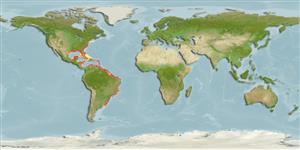
marinhas; estuarina bentopelágico; oceanódromo (Ref. 51243); intervalo de profundidade 1 - 70 m (Ref. 9626). Subtropical; 43°N - 38°S, 97°W - 35°W (Ref. 44847)
Western Atlantic: Massachusetts, USA through the Gulf of Mexico and scattered localities in the West Indies (Ref. 26938) to Brazil. Also found in Argentina (Ref. 44847). Absent from clear waters of Bahamas and similar islands (Ref. 7251).
Comprimento na primeira maturidade / Tamanho / Peso / Idade
Maturidade: Lm ?, range 25 - ? cm
Max length : 64.0 cm TL macho/indeterminado; (Ref. 7251); common length : 40.0 cm TL macho/indeterminado; (Ref. 5217); peso máx. Publicado: 3.8 kg (Ref. 40637); Idade máx. registada: 7 anos (Ref. 125592)
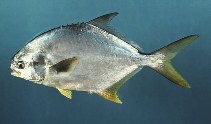
Adults occur in coastal waters, commonly entering bays and estuaries. Juveniles found in sandy beaches exposed to wave action (Ref. 5217). Adults are absent from insular areas with coralline habitats (Ref. 5217). They generally form small to large schools. They feed on mollusks, crustaceans and other invertebrates and small fish. Excellent food fish (Ref. 9626). Highest priced marine food fish in the USA (Ref. 171). Have been reared in captivity (Ref. 35420).
Ciclo de vida e comportamento de acasalamento
Maturidade | Reprodução | Desova | Ovos | Fecundidade | Larvas
Robins, C.R. and G.C. Ray, 1986. A field guide to Atlantic coast fishes of North America. Houghton Mifflin Company, Boston, U.S.A. 354 p. (Ref. 7251)
Categoria na Lista Vermelha da IUCN (Ref. 130435: Version 2025-2 (Global))
Ameaça para o homem
Harmless
Utilização humana
Pescarias: altamente comercial; Aquacultura: espécies comerciais; peixe desportivo: sim; Aquário: Aquários públicos
Ferramentas
Relatórios especiais
Descarregue XML
Fontes da internet
Estimativas baseadas em modelos
Temperatura preferida (Ref.
123201): 23.3 - 28, mean 25.6 °C (based on 454 cells).
Índice de diversidade filogenética (Ref.
82804): PD
50 = 0.5000 [Uniqueness, from 0.5 = low to 2.0 = high].
Bayesian length-weight: a=0.01585 (0.00893 - 0.02811), b=2.82 (2.67 - 2.97), in cm total length, based on LWR estimates for this species & Genus-body shape (Ref.
93245).
Nível Trófico (Ref.
69278): 3.5 ±0.6 se; based on diet studies.
Resiliência (Ref.
120179): Médio, tempo mínimo de duplicação da população 1,4 - 4,4 anos (K=0.40; assumed tm=1-2; tmax=7).
Vulnerabilidade da pesca (Ref.
59153): Low to moderate vulnerability (27 of 100).
🛈
Vulnerabilidade climática (Ref.
125649): High to very high vulnerability (69 of 100).
🛈
Nutrientes (Ref.
124155): Calcium = 57.7 [29.8, 115.8] mg/100g; Iron = 0.97 [0.54, 2.04] mg/100g; Protein = 18.8 [16.7, 20.8] %; Omega3 = 0.281 [0.153, 0.553] g/100g; Selenium = 30.8 [15.2, 64.5] μg/100g; VitaminA = 7.89 [2.08, 26.10] μg/100g; Zinc = 0.721 [0.478, 1.101] mg/100g (wet weight);