>
Gobiiformes (Gobies) >
Gobiidae (Gobies) > Gobiinae
Etymology: Tomiyamichthys: occurring on sand-rubble bottoms in the vicinity of coral reefs; stuarti: Named for Stuart Mathews Brooks, the third author’s son.
Eponymy: Stuart Mathews Brooks is the son of the third author William M Brooks. (Also see Berry (Levy), Bill (Brooks) & Jack Brooks) (Ref. 128868), visit book page.
Ambiente: milieu / zona climatica / distribuzione batimetrica / gamma di distribuzione
Ecologia
marino associati a barriera corallina; distribuzione batimetrica ? - 30 m (Ref. 119393). Tropical
Western Central Pacific: Papua New Guinea.
Dimensione / Peso / Età
Maturità: Lm ? range ? - ? cm
Max length : 2.4 cm SL maschio/sesso non determinato; (Ref. 119393)
Breve descrizione
Chiavi di identificazione | Morfologia | Morfometria
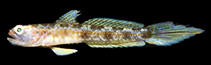
Spine dorsali (totale) : 7; Raggi dorsali molli (totale) : 11; Spine anali: 1; Raggi anali molli: 11; Vertebre: 26. This species is distinguished by the following set of characters: D VI-I,11; A I,11; pectoral-fin rays 15; scales in longitudinal series 51-6; no les o cheek, opercle, predorsal, prepelvic, and pectoral-fin base; scales weakly ctenoid, cycloid on anterodorsal part of body and belly; gill opening extending slightly forward of level of posterior margin of preopercle; dorsal fin without elongate spines, the longest 1.9-2.8 in HL; caudal fin is long and pointed, 2.1-2.2 in SL; reduced pattern of cephalic sensory-canal pores consisting of only B’, C, D, E, F and G pores (i.e. no preopercular pores M’, N, and O’ and no pores K’ and L’ above the operculum); gill rakers are poorly developed, 0 + 4-5 (Ref. 119393).
Cross section: oval.
Found on a flat muddy bottom in a sheltered bay with a mangrove shoreline. It is presumed to live in burrows and, like other members of the genus, is associated with snapping shrimps of the genus Alpheus Ref. 119393).
Ciclo vitale e comportamento di accoppiamento
Maturità | Riproduzione | Deposizione | Uova | Fecondità | Larve
Allen, G.R., M.V. Erdmann and W.M. Brooks, 2018. A new species of Tomiyamichthys (Pisces: Gobiidae) from Papua New Guinea. J. Ocean Sci. Found. 31:38-46. (Ref. 119393)
Stato della Lista Rossa IUCN (Ref. 130435: Version 2025-2 (Global))
Minaccia per l'uomo
Harmless
Usi umani
Pesca: di nessun interesse
Strumenti
Rapporti speciali
Scarica XML
Fonti Internet
Stime basate su modelli
Indice di diversità filogenetica (Fonte Biblio.
82804): PD
50 = 0.5000 [Uniqueness, from 0.5 = low to 2.0 = high].
Bayesian length-weight: a=0.00741 (0.00347 - 0.01582), b=3.09 (2.91 - 3.27), in cm total length, based on LWR estimates for this (Sub)family-body shape (Ref.
93245).
Livello trofico (Fonte Biblio.
69278): 3.1 ±0.3 se; based on size and trophs of closest relatives
Resilienza (Fonte Biblio.
120179): Alto, tempo minimo di raddoppiamento della popolazione meno di 15 mesi (Preliminary K or Fecundity.).
Vulnerabilità della pesca (Ref.
59153): Low vulnerability (10 of 100).
🛈