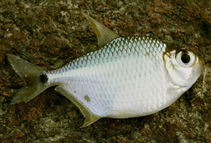
>
Characiformes (Characins) >
Characidae (Characins; tetras) > Tetragonopterinae
Etymology: Tetragonopterus: Name from Greek words: 'Tetra' meaning four; 'gonia' meaning angle; 'pteron' for fin; referring to the evident tetragonal shape of the body (Ref. 124043).
More on authors: Spix & Agassiz.
Ambiente: milieu / zona climatica / distribuzione batimetrica / gamma di distribuzione
Ecologia
; acqua dolce pelagico; pH range: 5.0 - 7.5; dH range: ? - 20. Tropical; 20°C - 28°C (Ref. 1672)
South America: Amazon basin (including rio Tocantins), Orinoco and the Atlantic drainages of the Guianas (Essequibo, Corantijn and Marowijne river basins).
Dimensione / Peso / Età
Maturità: Lm ? range ? - ? cm
Max length : 12.7 cm TL maschio/sesso non determinato; (Ref. 111518); peso massimo pubblicato: 40.20 g (Ref. 111518)
Raggi dorsali molli (totale) : 9; Raggi anali molli: 26 - 33; Vertebre: 30 - 31. This species is distinguished from T. anostomus, T. denticulatus, T. juruena, T. kuluene by the principal teeth on dentary 4 (vs. 5-6), and having larger and more robust teeth (vs. thinner and sharper teeth); differs from T. anostomus, T. araguaiensis by the gill-rakers on lower limb of the first gill arch 11-14 (vs. 17-20); differs from T. carvalhoi by the rounded dark mark on the caudal peduncle (vs. lozenge-shaped); differs from T. anostomus by having a terminal mouth (vs. subsuperior); differs from T. anostomus, T. kuluene by the conspicuous humeral marks 2 (vs. 1); differs from T. argenteus by the predorsal scales 7-9 (vs. 11-17); differs from T. franciscoensis by the number of olfactory lamellae 20-40 (vs. 11-17) and by having more robust teeth on dentary (vs. thinner and sharper teeth); differs from T. denticulatus by having humeral marks separated by a single vertical scale row (vs. marks separated by three vertical scale rows); differs from T. rarus by lacking the longitudinal dark stripes on the trunk (vs. presence); differs from T. rarus, T. georgiae by the scale rows between lateral line and pelvic fin origin 3.5 (vs. 4.5-5.5); differs from T. ommatus by the teeth on the maxilla 1-4 (vs. 7-8) and by having a conspicuous dark mark on the caudal peduncle (vs. inconspicuous and limited to the posterior part of the caudal peduncle) (Ref. 124043)
Cross section: compressed.
Occurs in creeks with rapidly flowing water over sandy areas and slow flowing water over plant debris (Ref. 12225).
Ciclo vitale e comportamento di accoppiamento
Maturità | Riproduzione | Deposizione | Uova | Fecondità | Larve
Silva, G.S.C., B.F. Melo, C. Oliveira and R.C. Benine, 2016. Revision of the South American genus Tetragonopterus Cuvier, 1816 (Teleostei: Characidae) with description of four new species. Zootaxa 4200(1):1-46. (Ref. 124043)
Stato della Lista Rossa IUCN (Ref. 130435: Version 2025-2 (Global))
Minaccia per l'uomo
Harmless
Usi umani
Pesca: commerciale; Acquario: Commerciale
Strumenti
Rapporti speciali
Scarica XML
Fonti Internet
Stime basate su modelli
Indice di diversità filogenetica (Fonte Biblio.
82804): PD
50 = 0.5000 [Uniqueness, from 0.5 = low to 2.0 = high].
Bayesian length-weight: a=0.02399 (0.01447 - 0.03977), b=3.01 (2.87 - 3.15), in cm total length, based on LWR estimates for this species & Genus-body shape (Ref.
93245).
Livello trofico (Fonte Biblio.
69278): 3.6 ±0.4 se; based on size and trophs of closest relatives
Vulnerabilità della pesca (Ref.
59153): Low vulnerability (10 of 100).
🛈