>
Siluriformes (Catfishes) >
Mochokidae (Squeakers or upside-down catfishes) > Mochokinae
Etymology: Synodontis: Greek, syn, symphysis = grown together + Greek, odous = teeth (Ref. 45335).
Eponymy: John Samuel Budgett (1872–1904) was an embryologist, ichthyologist, naturalist, artist and explorer, employed by Trinity College, Cambridge. [...] (Ref. 128868), visit book page.
More on author: Boulenger.
Ambiente: milieu / zona climática / intervalo de profundidade / gama de distribuição
Ecologia
; Água doce bentopelágico; pH range: 6.2 - 7.2; dH range: 6 - 20. Tropical; 22°C - 27°C (Ref. 12468); 10°N - 4°N
Africa: endemic to the Niger River basin, including the Benue (Ref. 57223). Report from the Ouémé (Benin) (Ref. 3202) refers to misidentified S. melanopterus specimens (see DVD version of Ref. 57223). Report from the Chari-Logone (Chad basin) in Central African Republic (see map in Ref. 57223) questionable.
Comprimento na primeira maturidade / Tamanho / Peso / Idade
Maturidade: Lm ?, range 20 - ? cm
Max length : 40.0 cm SL macho/indeterminado; (Ref. 31256)
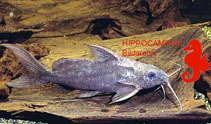
Espinhos dorsais (total) : 1; Espinhos anais: 0. Diagnosis: gill slits not extending ventrally beyond pectoral-fin insertions; maxillary barbels distinctly fringed, longer than head, unbranched and lacking tubercles, but with a broad, long and dark basal membrane; outer mandibular barbels with few simple, short ramifications, inner mandibular barbels with tuberculate, subdivided branches; mandibular teeth moderately developed, numbering 45-64 (64 in the holotype); denticulations on pectoral-fin spines weaker on outer than on inner margin; dorsal-fin spine smooth anteriorly; first ray of dorsal and pectoral fins, as well as both caudal-fin lobes extended into filaments; humeral process pointed, granulose, its ventral margin keeled and bearing 3 backward-pointing spines (sometimes only 1 or 2 in young individuals); adipose fin normally developed and distinctly separated from rayed dorsal fin (Ref. 57223).
Coloration: ground colour uniformly greenish-yellow; series of black spots sometimes present on fins in young individuals (Ref. 57223).
Body shape (shape guide): elongated.
Oviparous (Ref. 205). Maximum size 395mm TL, 297mm SL (Ref. 57223).
Ciclo de vida e comportamento de acasalamento
Maturidade | Reprodução | Desova | Ovos | Fecundidade | Larvas
Oviparous (Ref. 205). Distinct pairing during breeding (Ref. 205).
Paugy, D. and T.R. Roberts, 2003. Mochokidae. p. 195-268 In C. Lévêque, D. Paugy and G.G. Teugels (eds.) Faune des poissons d'eaux douce et saumâtres de l'Afrique de l'Ouest, Tome 2. Coll. Faune et Flore tropicales 40. Musée Royal de l'Afrique Centrale, Tervuren, Belgique, Museum National d'Histoire Naturalle, Paris, France and Institut de Recherche pour le Développement, Paris, France. 815 p. (Ref. 57223)
Categoria na Lista Vermelha da IUCN (Ref. 130435: Version 2025-2 (Global))
Ameaça para o homem
Harmless
Utilização humana
Pescarias: espécies comerciais
Ferramentas
Relatórios especiais
Descarregue XML
Fontes da internet
Estimativas baseadas em modelos
Índice de diversidade filogenética (Ref.
82804): PD
50 = 0.5000 [Uniqueness, from 0.5 = low to 2.0 = high].
Bayesian length-weight: a=0.01096 (0.00461 - 0.02608), b=3.00 (2.81 - 3.19), in cm total length, based on LWR estimates for this Genus-body shape (Ref.
93245).
Nível Trófico (Ref.
69278): 2.8 ±0.3 se; based on size and trophs of closest relatives
Generation time: 3.6 ( na - na) years. Estimated as median ln(3)/K based on 1
growth studies.
Resiliência (Ref.
120179): Médio, tempo mínimo de duplicação da população 1,4 - 4,4 anos (K=0.3).
Vulnerabilidade da pesca (Ref.
59153): Moderate vulnerability (35 of 100).
🛈