Elasmobranchii (tubarões e raias) (sharks and rays) >
Squaliformes (Sleeper and dogfish sharks) >
Squalidae (Dogfish sharks)
Etymology: Squalus: Genus name from Latin 'squalus' meaning shark (Ref. 6885, 27436).
More on authors: White, Last & Yearsley.
Ambiente: milieu / zona climática / intervalo de profundidade / gama de distribuição
Ecologia
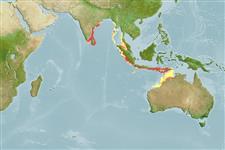
marinhas bentopelágico; intervalo de profundidade 1 - 100 m (Ref. 58445). Tropical
Eastern Indian Ocean.
Comprimento na primeira maturidade / Tamanho / Peso / Idade
Maturidade: Lm ?, range 43 - ? cm
Max length : 52.2 cm TL macho/indeterminado; (Ref. 58445); 78.0 cm TL (female)
Descrição breve
Chaves de identificação | Morfologia | Morfometria
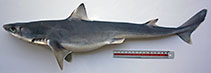
This species is distinguished by the following set of characters: slender body of moderate size, depth 9-10.6% TL; relatively narrow and very short snout, horizontal prenarial length is 8.4-9.1% TL; large eyes, length 5.1-5.6% TL; secondary lobe of anterior nasal flap is well developed; small dorsal fins that are strongly raked; first dorsal-fin spine is moderate, broad-based while the second dorsal-fin spine is moderate, robust and broad-based; weakly falcate pectoral fin in adults its inner margin relatively short, 6.9-7.8% TL; caudal fin with a short, broad caudal bar, enlarged upper caudal blotch and the fringe is located distally on lobe in juveniles; flank denticles are broadly unicuspidate to weakly tricuspidate; monospondylous centra 35-38, precaudal centra 72-76, total centra 96-100 (Ref. 58445).
Body shape (shape guide): elongated.
Apparently occurs on or near the bottom of upper continental and insular slopes, but depth distribution is undetermined; probably on shallower water than its congeners. Presumably feeds on small fishes, cephalopods and crustaceans. Viviparous, with yolk-sac dependency. Gives birth to 3 -10 pups, but gestation period is unknown. Males mature at about 43 cm TL and females by 61 cm TL; with largest embryo measured at 18 cm. The species is a very common catch component fo the demersal longline fishery in deepwater areas in eastern Indonesia. It is caught for its meat, fins and liver oil (Ref. 58042).
Ciclo de vida e comportamento de acasalamento
Maturidade | Reprodução | Desova | Ovos | Fecundidade | Larvas
Distinct pairing with embrace (Ref. 205).
White, W.T., P.R. Last and G.K. Yearsley, 2007. Squalus hemipinnis sp. Nov., a new short-snout spurdog from eastern Indonesia. pp. 101-108. In P.R. Last, W.T. White and J.J. Pogonoski Descriptions of new dogfishes of the genus Squalus (Squaloidea: Squalidae). CSIRO Marine and Atmospheric Research Paper No. 014. 130 pp. (Ref. 58445)
Categoria na Lista Vermelha da IUCN (Ref. 130435: Version 2025-2 (Global))
Ameaça para o homem
Harmless
Utilização humana
Pescarias: de interesse potencial
Ferramentas
Relatórios especiais
Descarregue XML
Fontes da internet
Estimativas baseadas em modelos
Temperatura preferida (Ref.
123201): 25.6 - 28.7, mean 28.3 °C (based on 20 cells).
Índice de diversidade filogenética (Ref.
82804): PD
50 = 0.5000 [Uniqueness, from 0.5 = low to 2.0 = high].
Bayesian length-weight: a=0.00347 (0.00163 - 0.00737), b=3.09 (2.92 - 3.26), in cm total length, based on LWR estimates for this Genus-body shape (Ref.
93245).
Nível Trófico (Ref.
69278): 4.3 ±0.3 se; based on size and trophs of closest relatives
Resiliência (Ref.
120179): Baixo, tempo mínimo de duplicação da população 4,5 - 14 anos (Preliminary K or Fecundity.).
Vulnerabilidade da pesca (Ref.
59153): Moderate to high vulnerability (51 of 100).
🛈