Classificazione / Nomi
Nomi Comuni | Sinonimi | Catalog of Fishes(Genere, Specie) | ITIS | CoL | WoRMS | Cloffa
Taxonomic Remarks
Generic placement is tentative. This species lacks several osteological characters diagnostic for the genus and preliminary molecular data place it close to Petroleuciscus (Ref. 59043).
Ambiente: milieu / zona climatica / distribuzione batimetrica / gamma di distribuzione
Ecologia
; acqua dolce benthopelagico. Temperate
Europe: Kuban drainage from Adagum to Laba systems.
Dimensione / Peso / Età
Maturità: Lm ? range ? - ? cm
Max length : 16.0 cm SL maschio/sesso non determinato; (Ref. 59043)
Breve descrizione
Chiavi di identificazione | Morfologia | Morfometria
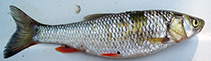
Diagnosed from its congeners in Black Sea basin by having the following characters: anal fin with 9½ branched rays; 36-41 + 3 scales on lateral line; interorbital distance 32-35% HL; postorbital distance 45-47% HL; eye diameter 22-26% HL, 1.3-1.5 times in snout length; body depth 21-27% SL; a row of black pigment along free margin of each flank scale, forming a regular reticulate pattern; anal and pelvic fins orange to red (Ref. 59043).
Body shape (shape guide): fusiform / normal.
Inhabits piedmont and mountain streams with Mediterranean water regime, strong to moderate current, rock or gravel bottom. Abundant along shores and may be restricted to very small pools during summer. Feeds predominantly on terrestrial insects, benthic invertebrates and algae. Breeds in shallow riffle habitats, with strong current and stone or pebble bottom, at 10-20 cm water depth. Moves downstream in winter to deeper pools and to uppermost stretches of streams in summer (Ref. 59043).
Ciclo vitale e comportamento di accoppiamento
Maturità | Riproduzione | Deposizione | Uova | Fecondità | Larve
Spawns in shallow riffles, with strong current and stone or pebble bottom, at 10-20 cm water depth. Females deposit eggs in 2-3 portions throughout the spawning period. Eggs are 1.9 in diameter, orange, adhere to pebbles and hatch in 3 days. Larvae do not possess adhesive glands, are negatively phototactic and hide under stones. They drift to shallow areas after active feeding activity commences (Ref. 59043).
Kottelat, M. and J. Freyhof, 2007. Handbook of European freshwater fishes. Publications Kottelat, Cornol and Freyhof, Berlin. 646 pp. (Ref. 59043)
Stato della Lista Rossa IUCN (Ref. 130435: Version 2025-2 (Global))
Minaccia per l'uomo
Harmless
Usi umani
Pesca: di nessun interesse
Strumenti
Rapporti speciali
Scarica XML
Fonti Internet
Stime basate su modelli
Indice di diversità filogenetica (Fonte Biblio.
82804): PD
50 = 0.5000 [Uniqueness, from 0.5 = low to 2.0 = high].
Bayesian length-weight: a=0.00794 (0.00402 - 0.01570), b=3.13 (2.97 - 3.29), in cm total length, based on LWR estimates for this Genus-body shape (Ref.
93245).
Livello trofico (Fonte Biblio.
69278): 3.3 ±0.4 se; based on size and trophs of closest relatives
Resilienza (Fonte Biblio.
120179): Medio, tempo minimo di raddoppiamento della popolazione 1.4 - 4.4 anni (Preliminary K or Fecundity.).
Vulnerabilità della pesca (Ref.
59153): Low vulnerability (10 of 100).
🛈