>
Carangaria/misc (Various families in series Carangaria) >
Sphyraenidae (Barracudas)
Etymology: Sphyraena: Greek, sphyraina, -es = the name of a fish (Ref. 45335).
Eponymy: Edmund Heller (1875–1939) was an American zoologist. [...] (Ref. 128868), visit book page.
Taxonomic Remarks
References and information for Hawaii are retained (including common names). All other references from different study areas are questionable or refer to another species of Sphyraena.
Ambiente: milieu / zona climatica / distribuzione batimetrica / gamma di distribuzione
Ecologia
marino associati a barriera corallina; distribuzione batimetrica 10 - 104 m (Ref. 58302). Subtropical; 23°N - 18°N, 161°W - 154°W (Ref. 123366)
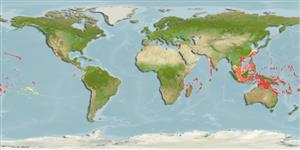
Eastern Pacific: Hawaii endemic.
Dimensione / Peso / Età
Maturità: Lm ? range ? - ? cm
Max length : 54.6 cm SL maschio/sesso non determinato; (Ref. 123366); peso massimo pubblicato: 1.8 kg (Ref. 4887)
Spine dorsali (totale) : 6; Raggi dorsali molli (totale) : 9; Spine anali: 2; Raggi anali molli: 8 - 9. This species is distinguished by the following set of characters: first gill arch with one gill raker; pelvic-fin insertion is located slightly before vertical through first dorsal-fin origin; pored lateral-line scales 121-127, total lateral-line scales 132-134; scales above lateral line 12-13 and below 14-15; snout comparatively long, its length 15.0-16.4% SL; upper jaw long, the posterior tip reaching to or beyond anterior nostril, but not reaching to below posterior nostril, its length 11.9-12.9% SL; eye large, orbit diameter 4.8-5.9 % SL and depth 4.8-5.6% SL; anal-fin base somewhat short, its length 6.8-7.5% SL; last dorsal- and anal-fin ray lengths 4.2-4.3% SL and 3.6-4.7% SL, respectively; anus is comparatively close to anal-fin origin, its anterior and posterior margins to anal-fin origin 6.5-8.2 % HL and 4.1-4.9% HL, respectively; the head sensory canal pores on suborbital area are simple or sometimes slightly branched, their lowermost parts very close to lacrimal bone margin, large smooth area lacking canal pores absent on mid-margin of lacrimal bone. Colouration: lateral surface of body no stripes or bands; caudal fin gray (Ref. 123366).
Cross section: compressed.
Mainly nocturnal (Ref. 4887).
Ciclo vitale e comportamento di accoppiamento
Maturità | Riproduzione | Deposizione | Uova | Fecondità | Larve
Morishita, S. and H. Motomura, 2020. Sphyraena stellata, a new barracuda from the Indo-Pacific, with redescriptions of S. helleri Jenkins, 1901 and S. novaehollandiae Günther, 1860 (Perciformes: Sphyraenidae). Zootaxa 4772(3):545-566. (Ref. 123366)
Stato della Lista Rossa IUCN (Ref. 130435: Version 2025-2 (Global))
Minaccia per l'uomo
Harmless
Usi umani
Pesca: commerciale
Strumenti
Rapporti speciali
Scarica XML
Fonti Internet
Stime basate su modelli
Temperatura preferita (Fonte Biblio.
123201): 24.7 - 28.8, mean 27.5 °C (based on 566 cells).
Indice di diversità filogenetica (Fonte Biblio.
82804): PD
50 = 0.5000 [Uniqueness, from 0.5 = low to 2.0 = high].
Bayesian length-weight: a=0.00708 (0.00326 - 0.01539), b=2.92 (2.74 - 3.10), in cm total length, based on LWR estimates for this Genus-body shape (Ref.
93245).
Livello trofico (Fonte Biblio.
69278): 4.5 ±0.80 se; based on food items.
Resilienza (Fonte Biblio.
120179): Medio, tempo minimo di raddoppiamento della popolazione 1.4 - 4.4 anni (Preliminary K or Fecundity.).
Vulnerabilità della pesca (Ref.
59153): Moderate to high vulnerability (47 of 100).
🛈
Nutrienti (Ref.
124155): Calcium = 10.3 [4.7, 30.8] mg/100g; Iron = 0.285 [0.122, 0.637] mg/100g; Protein = 20.9 [18.9, 22.6] %; Omega3 = 0.141 [0.060, 0.310] g/100g; Selenium = 17.5 [6.8, 45.7] μg/100g; VitaminA = 29.3 [5.9, 164.1] μg/100g; Zinc = 0.303 [0.180, 0.533] mg/100g (wet weight);