>
Acanthuriformes (Surgeonfishes) >
Siganidae (Rabbitfishes)
Etymology: Siganus: Latin, siganus = a fish, rabbit fish; by the similarity of the nose (Ref. 45335).
More on author: Bloch.
Ambiente: milieu / zona climática / intervalo de profundidade / gama de distribuição
Ecologia
marinhas; estuarina associadas(os) a recifes; intervalo de profundidade 0 - 25 m (Ref. 90102). Tropical; 24°C - 28°C (Ref. 27115); 30°N - 30°S
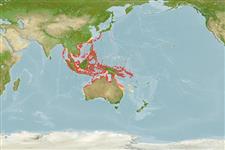
Eastern Indian Ocean and Western Pacific: Andaman Islands, Thailand, Malaysia, Singapore, Indonesia (including Irian Jaya), Viet Nam, Ryukyus, southern and eastern China, Taiwan, South China Sea, Philippines, and Palau. Replaced by Siganus lineatus to the west, south and east of the region described by the said localities.
Comprimento na primeira maturidade / Tamanho / Peso / Idade
Maturidade: Lm 18.1, range 12 - ? cm
Max length : 42.0 cm TL macho/indeterminado; (Ref. 9710); common length : 25.0 cm TL macho/indeterminado; (Ref. 9813)
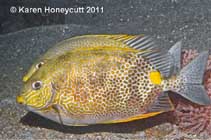
Espinhos dorsais (total) : 13; Raios dorsais moles (total) : 10; Espinhos anais: 7; Raios anais moles: 9; Vértebras: 13. Dusky blue dorsally, silvery below; a bright yellow spot adjacent to last few rays of dorsal fin; head with lines and spots. Preopercular angle 91°-102°; strong scales fully cover the cheeks; midline of thorax scaled, not the pelvic ridges. Anterior nostril with extremely low rim, slightly expanded posteriorly. Spines stout, pungent, venomous.
Body shape (shape guide): short and / or deep; Cross section: compressed.
Inhabits turbid inshore reefs among mangroves; tolerates or even prefers low salinities. Fry settles in seagrass beds around river mouths and adults enter and leave rivers with the tide, but also found on the drop-offs of inshore fringing reefs down to 6 m. Schools throughout life; school size for adults around 10 or 15. Feeds on benthic algae. Unlike other siganids, this species is reported to be active at night. Sold fresh in markets (Ref. 9813, 48637).
Ciclo de vida e comportamento de acasalamento
Maturidade | Reprodução | Desova | Ovos | Fecundidade | Larvas
Usually spawns at midnight.
Woodland, D.J., 1990. Revision of the fish family Siganidae with descriptions of two new species and comments on distribution and biology. Indo-Pac. Fish. (19):136 p. (Ref. 1419)
Categoria na Lista Vermelha da IUCN (Ref. 130435: Version 2025-2 (Global))
Utilização humana
Pescarias: espécies comerciais; Aquacultura: espécies comerciais; Aquário: Espécies comerciais
Ferramentas
Relatórios especiais
Descarregue XML
Fontes da internet
Estimativas baseadas em modelos
Temperatura preferida (Ref.
123201): 25.4 - 29.3, mean 28.7 °C (based on 2193 cells).
Índice de diversidade filogenética (Ref.
82804): PD
50 = 0.5000 [Uniqueness, from 0.5 = low to 2.0 = high].
Bayesian length-weight: a=0.01585 (0.01258 - 0.01996), b=3.04 (2.99 - 3.09), in cm total length, based on LWR estimates for this species (Ref.
93245).
Nível Trófico (Ref.
69278): 2.7 ±0.30 se; based on food items.
Generation time: 0.8 ( na - na) years. Estimated as median ln(3)/K based on 2
growth studies.
Resiliência (Ref.
120179): Elevada, tempo mínimo de duplicação da população menor que 15 meses (Preliminary K or Fecundity.).
Vulnerabilidade da pesca (Ref.
59153): Low vulnerability (19 of 100).
🛈
Nutrientes (Ref.
124155): Calcium = 42.8 [20.6, 111.6] mg/100g; Iron = 0.873 [0.393, 2.154] mg/100g; Protein = 19.2 [17.7, 20.8] %; Omega3 = 0.115 [0.054, 0.240] g/100g; Selenium = 30.7 [10.6, 83.4] μg/100g; VitaminA = 13.9 [3.1, 62.6] μg/100g; Zinc = 1.46 [0.56, 3.27] mg/100g (wet weight);