>
Scombriformes (Mackerels) >
Centrolophidae (Medusafishes)
Etymology: Schedophilus: Name from Greek words 'phylos' (Φίλος), t) meaning 'one who likes' and "s 'shedia' (Σχεδία) which means raft; literally means 'the one who likes rafts'. This probably refers to the lifestyle ot the juveniles of this genus (Michail Ragousis, mar10091@marine.aegean.gr, pers. Comm. 01/16) which are epipelagic and associate with floating jellyfish.
More on author: Cuvier.
Meio ambiente: milieu / Zona climática / intervalo de profundidade / faixa de distribuição
Ecologia
marinhas bentopelágico; intervalo de profundidade 70 - 700 m (Ref. 52180). Subtropical; 52°N - 16°S, 65°W - 36°E
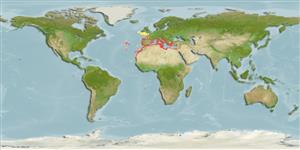
Eastern Atlantic: Spain and throughout most of the Mediterranean southward. Although reported to occur in South Africa (Ref. 4542, 6942), Smith 1995 (Ref. 11228) mentions that the species occurring in southern Africa is not Schedophilus ovalis but Schedophilus velaini. Western Central Atlantic: a small specimen recorded from Bermuda.
Tamanho / Peso / Idade
Maturidade: Lm ? range ? - ? cm
Max length : 100.0 cm TL macho/indeterminado; (Ref. 3596); common length : 60.0 cm TL macho/indeterminado; (Ref. 3596)
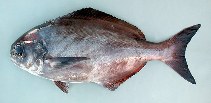
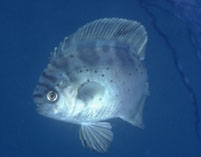
Prefers deep water at the edge of continental shelves and around oceanic islands; larger specimens near the bottom (Ref. 4542). Young are epipelagic and associate with floating jellyfish, including Physalia (Ref. 4542). Adults are caught on hooks baited with fish or squid. Its white flesh is reported to be good-tasting (Ref. 4542).
Ciclo de vida ou comportamento de acasalamento
Maturidade | Reprodução | Desova | Ovos | Fecundidade | Larvas
Haedrich, R.L., 1990. Centrolophidae. p. 1011-1013. In J.C. Quero, J.C. Hureau, C. Karrer, A. Post and L. Saldanha (eds.) Check-list of the fishes of the eastern tropical Atlantic (CLOFETA). JNICT, Lisbon; SEI, Paris; and UNESCO, Paris. Vol. 2. (Ref. 6942)
Status na Lista Vermelha da UICN (Ref. 130435: Version 2025-2 (Global))
Ameaça para os humanos
Harmless
Uso pelos humanos
Pescarias: espécies comerciais
Ferramentas
Relatórios especiais
Baixar XML
Fontes da internet
Estimativas baseadas em modelos
Temperatura preferida (Ref.
123201): 11.8 - 18.8, mean 14.8 °C (based on 221 cells).
Índice de diversidade filogenética (Ref.
82804): PD
50 = 0.5039 [Uniqueness, from 0.5 = low to 2.0 = high].
Bayesian length-weight: a=0.00832 (0.00406 - 0.01705), b=3.12 (2.94 - 3.30), in cm total length, based on LWR estimates for this species & (Sub)family-body (Ref.
93245).
Nível Trófico (Ref.
69278): 3.5 ±0.47 se; based on food items.
Resiliência (Ref.
120179): Baixo, tempo mínimo de duplicação da população 4,5 - 14 anos (Preliminary K or Fecundity.).
Vulnerabilidade da pesca (Ref.
59153): High vulnerability (60 of 100).
🛈
Vulnerabilidade climática (Ref.
125649): Moderate vulnerability (39 of 100).
🛈
Nutrientes (Ref.
124155): Calcium = 28.7 [14.5, 52.1] mg/100g; Iron = 0.619 [0.372, 1.095] mg/100g; Protein = 18 [16, 20] %; Omega3 = 0.279 [0.157, 0.489] g/100g; Selenium = 58.3 [26.8, 121.8] μg/100g; VitaminA = 7.9 [2.0, 32.3] μg/100g; Zinc = 0.544 [0.377, 0.841] mg/100g (wet weight);