Elasmobranchii (tubarões e raias) (sharks and rays) >
Rajiformes (Skates and rays) >
Rajidae (Skates)
Etymology: Dipturus: Greek, di = two + Greek, pteryx = fin (Ref. 45335).
More on author: Linnaeus.
Meio ambiente: milieu / Zona climática / intervalo de profundidade / faixa de distribuição
Ecologia
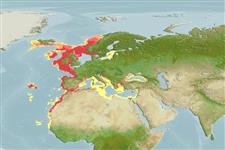
marinhas demersal; intervalo de profundidade 100 - 1000 m (Ref. 4426), usually 30 - 600 m (Ref. 127222). Temperate; 70°N - 48°N, 30°W - 20°E (Ref. 127222)
Northeast Atlantic from Iceland and Scandinavia to the Bay of Biscay, including the United Kingdom, Ireland, and coasts of northwest Europe, up to the Scandinavian Peninsula and into the Skagerrak and Kattegat.
Comprimento de primeira maturação / Tamanho / Peso / Idade
Maturidade: Lm 160.0 range ? - ? cm
Max length : 285 cm TL macho/indeterminado; (Ref. 35388); common length : 100.0 cm TL macho/indeterminado; (Ref. 3261); peso máx. publicado: 113.0 kg (Ref. 114424); idade máx. registrada: 51 anos (Ref. 4483)
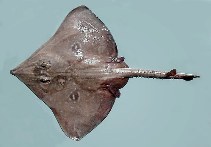
Espinhos dorsais (total) : 0; Espinhos anais: 0. This species is characterized by the following: snout broadly angular, length 5-6.3 times orbit length; disc broadly rhombic, anterior margin deeply concave; a row of 12-31 predorsal thorns in median row along tail (disc smooth in young; denticles confined to dorsal head and along anterior disc margin on both surfaces in adults; disc thorns small in young, largely absent in adults); lateral thorns on tail perpendicular to body axis; interspace between dorsal fins 1.2 ± 0.4 TL, the fins rounded, upright, near tail tip; upper surface olive-grey or brown with a variable pattern of light blotches, with yellowish ring-like markings; underside greyish; iris yellowish (Ref. 114953, 127223).
Body shape (shape guide): other; Cross section: flattened.
Benthic species in shelf and slope waters, mainly within the 200 m range along the continental shelf, but down to 600 m along continental slopes and seamounts (Ref. 127222). Feeds on all kinds of bottom invertebrates and fish, including other skates (Ref. 114953). Oviparous, with long embryonic development. Males reach maturity at ca. 115 cm TL, females at 123 cm TL; birth size at ca. 21 cm TL (Ref. 114953). Biology may be unclear due to past taxonomic confusion Distinct pairing with embrace. Young may tend to follow large objects, such as their mother (Ref. 205). Mate in spring and the egg capsules are laid during the summer. Eggs are oblong capsules with stiff pointed horns at the corners deposited in sandy or muddy flats (Ref. 205). Egg capsules are 10.6-24.5 cm long and 5.0-14.5 cm wide (Ref. 41250). About 40 eggs per individual are laid annually (Ref. 41250). Flesh is marketed fresh or smoked (Ref. 35388).
Ciclo de vida ou comportamento de acasalamento
Maturidade | Reprodução | Desova | Ovos | Fecundidade | Larvas
Oviparous, paired eggs are laid. Embryos feed solely on yolk (Ref. 50449). Egg-cases laid in spring and summer, very large (Ref. 3167). Distinct pairing with embrace. Young may tend to follow large objects, such as their mother (Ref. 205). Eggs have horn-like projections on the shell (Ref. 205).
McEachran, J.D. and K.A. Dunn, 1998. Phylogenetic analysis of skates, a morphologically conservative clade of elasmobranchs (Chondrichthyes: Rajidae). Copeia 1998(2):271-290. (Ref. 27314)
Status na Lista Vermelha da UICN (Ref. 130435: Version 2025-2 (Global))
Ameaça para os humanos
Harmless
Uso pelos humanos
Pescarias: pouco comercial; peixe esportivo: sim
Ferramentas
Relatórios especiais
Baixar XML
Fontes da internet
Estimativas baseadas em modelos
Temperatura preferida (Ref.
123201): 7.1 - 15, mean 9.8 °C (based on 243 cells).
Índice de diversidade filogenética (Ref.
82804): PD
50 = 0.5000 [Uniqueness, from 0.5 = low to 2.0 = high].
Bayesian length-weight: a=0.00331 (0.00198 - 0.00554), b=3.20 (3.06 - 3.34), in cm total length, based on LWR estimates for this species & Genus-body shape (Ref.
93245).
Nível Trófico (Ref.
69278): 3.5 ±0.6 se; based on diet studies.
Generation time: 19.3 ( na - na) years. Estimated as median ln(3)/K based on 1
growth studies.
Resiliência (Ref.
120179): Muito baixo(a), tempo mínimo de duplicação da população maior que 14 anos (K=0.06; tm=11; tmax=51; fec = 40).
Vulnerabilidade da pesca (Ref.
59153): Very high vulnerability (86 of 100).
🛈
Vulnerabilidade climática (Ref.
125649): Moderate vulnerability (42 of 100).
🛈
Nutrientes (Ref.
124155): Calcium = 5.44 [0.70, 105.27] mg/100g; Iron = 0.623 [0.058, 8.004] mg/100g; Protein = 16.2 [14.1, 18.2] %; Omega3 = 0.357 [0.147, 0.840] g/100g; Selenium = 50.9 [9.5, 261.5] μg/100g; VitaminA = 4.02 [0.31, 51.49] μg/100g; Zinc = 0.371 [0.023, 4.306] mg/100g (wet weight);