>
Perciformes/Scorpaenoidei (Scorpionfishes) >
Scorpaenidae (Scorpionfishes or rockfishes) > Scorpaeninae
Etymology: Pteroidichthys: Greek, pteron = wing, fin + Greek, ichthys = fish (Ref. 45335); acutus: Name from Latin 'acutus' meaning sharp; referring to having the longest and sharpest snout of species in the genus Pteroidichthys.
Ambiente: milieu / zona climatica / distribuzione batimetrica / gamma di distribuzione
Ecologia
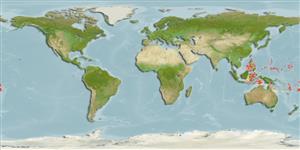
marino pelagic-neritic; distribuzione batimetrica 73 - 400 m (Ref. 106976). Tropical; 20°N - 27°S, 115°E - 178°W (Ref. 106976)
Western Pacific: from the Philippines, Vanuatu, and the Wallis and Futuna Islands.
Dimensione / Peso / Età
Maturità: Lm ? range ? - ? cm
Max length : 4.1 cm SL maschio/sesso non determinato; (Ref. 106976)
Breve descrizione
Chiavi di identificazione | Morfologia | Morfometria
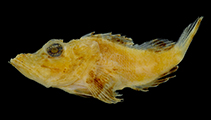
Spine dorsali (totale) : 7; Raggi dorsali molli (totale) : 9; Spine anali: 3; Raggi anali molli: 5. This species is distinguished by the following characters: A III.5; rigid dorsal-fin spines; relatively long snout with length 18.0-21.2% (mean 19.6%) of SL, and is longer than postorbital length; posterior margin of maxilla just reaching to or short of vertical through the anterior margin of pupil; the distance between tips of lateral lacrimal and first suborbital spines is longer than that between tips of first and second suborbital spines; presence of supplemental preopercular spine; tentacles on supraocular and posterior lacrimal spines are poorly developed, lengths are less than orbit diameter; with few tentacles on trunk and fins; lateral lacrimal and suborbital spines are well developed, with pointed tips; membranes between last spine and fourth soft ray of dorsal fin with a large black blotch (Ref. 106976).
Body shape (shape guide): fusiform / normal; Cross section: compressed.
Most probably found on sandy bottoms (Ref. 106976).
Ciclo vitale e comportamento di accoppiamento
Maturità | Riproduzione | Deposizione | Uova | Fecondità | Larve
Motomura, H. and Y. Kanade, 2015. Review of the scorpionfish genus Pteroidichthys (Scorpaenidae), with descriptions of two new species. Zootaxa 4057(4):490-510. (Ref. 106976)
Stato della Lista Rossa IUCN (Ref. 130435: Version 2025-2 (Global))
Minaccia per l'uomo
Harmless
Usi umani
Strumenti
Rapporti speciali
Scarica XML
Fonti Internet
Stime basate su modelli
Indice di diversità filogenetica (Fonte Biblio.
82804): PD
50 = 0.5625 [Uniqueness, from 0.5 = low to 2.0 = high].
Bayesian length-weight: a=0.01288 (0.00626 - 0.02652), b=3.02 (2.85 - 3.19), in cm total length, based on LWR estimates for this (Sub)family-body shape (Ref.
93245).
Livello trofico (Fonte Biblio.
69278): 3.3 ±0.5 se; based on size and trophs of closest relatives
Resilienza (Fonte Biblio.
120179): Alto, tempo minimo di raddoppiamento della popolazione meno di 15 mesi (Preliminary K or Fecundity.).
Vulnerabilità della pesca (Ref.
59153): Low vulnerability (10 of 100).
🛈