Ambiente: milieu / zona climática / intervalo de profundidade / gama de distribuição
Ecologia
; Água doce pelágico(a,os,as). Tropical; 7°N - 8°S
Africa: middle and upper Congo River basin (Ref. 3509, 28136, 93833), especially in northern and eastern tributaries (Ref. 188, 122734), and lower Congo River (Ref. 42510), in Central African Republic (Ref. 45441), Republic of Congo (Ref. 83895) and Democratic Republic of the Congo (Ref. 42480).
Tamanho / Peso / Idade
Maturidade: Lm ? range ? - ? cm
Max length : 6.0 cm SL macho/indeterminado; (Ref. 188)
Descrição breve
Chaves de identificação | Morfologia | Morfometria
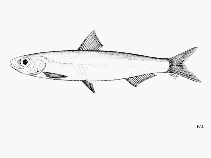
Espinhos dorsais (total) : 0; Raios dorsais moles (total) : 13 - 15; Espinhos anais: 0; Raios anais moles: 16 - 20. Diagnosis: Body slender, its depth 18-27% of standard length; pre-pelvic scutes not strongly keeled, beginning under or behind base of last pectoral finray, 7-10 pre-pelvic and 9-12 post-pelvic scutes, belly rounded; snout bluntly rounded; lower jaw not projecting, exactly meeting tip of upper when mouth closed, deepest at mid-point of jaw, with small saw-like teeth on each side; pre-maxillae with small teeth pointing downward; maxilla very slender, its blade over 3 times as long as deep, upper edge ridged, lower edge without denticulations; posterior supra-maxilla very small, spatulate, its shaft about as long as its blade; lower gillrakers 14-16; silver stripe on flank, narrower anteriorly (Ref. 188, 28136). It differs from Potamothrissa whiteheadi in having a distinct shaft to the posterior supra-maxilla and lacking dermal denticles on the snout, and from P. acutirostris in its blunt snout and fewer gillrakers, 14-16 vs. 16-18 (Ref. 188, 28136). Other pellonulines lack saw-like teeth at the sides of the lower jaw (Ref. 188).
Body shape (shape guide): fusiform / normal; Cross section: compressed.
Found in rivers and streams (Ref. 41580), perhaps not in lakes (Ref. 188). It feeds on aquatic insects and also hydracarians (Ref. 188, 41580).
Ciclo de vida e comportamento de acasalamento
Maturidade | Reprodução | Desova | Ovos | Fecundidade | Larvas
Whitehead, P.J.P., 1985. FAO Species Catalogue. Vol. 7. Clupeoid fishes of the world (suborder Clupeoidei). An annotated and illustrated catalogue of the herrings, sardines, pilchards, sprats, shads, anchovies and wolf-herrings. FAO Fish. Synop. 125(7/1):1-303. Rome: FAO. (Ref. 188)
Categoria na Lista Vermelha da IUCN (Ref. 130435: Version 2025-2 (Global))
Ameaça para o homem
Harmless
Utilização humana
Pescarias: pescarias de subsistência
Ferramentas
Relatórios especiais
Descarregue XML
Fontes da internet
Estimativas baseadas em modelos
Índice de diversidade filogenética (Ref.
82804): PD
50 = 0.6250 [Uniqueness, from 0.5 = low to 2.0 = high].
Bayesian length-weight: a=0.00871 (0.00414 - 0.01834), b=3.06 (2.89 - 3.23), in cm total length, based on LWR estimates for this (Sub)family-body shape (Ref.
93245).
Nível Trófico (Ref.
69278): 3.2 ±0.40 se; based on food items.
Resiliência (Ref.
120179): Elevada, tempo mínimo de duplicação da população menor que 15 meses (Preliminary K or Fecundity.).
Vulnerabilidade da pesca (Ref.
59153): Low vulnerability (10 of 100).
🛈