Ambiente: milieu / zona climatica / distribuzione batimetrica / gamma di distribuzione
Ecologia
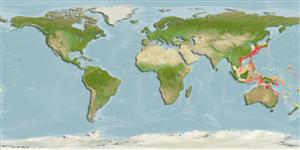
marino demersale; distribuzione batimetrica 65 - 278 m (Ref. 50734). Tropical
Western Pacific: Japan and Taiwan to New South Wales, Australia.
Dimensione / Peso / Età
Maturità: Lm ? range ? - ? cm
Max length : 19.0 cm TL maschio/sesso non determinato; (Ref. 9792)
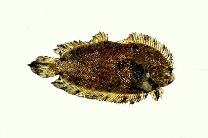
Raggi dorsali molli (totale) : 66 - 72; Raggi anali molli: 51 - 57. Feebly pigmented snout, presence of supratemporal branch on lateral line of ocular side and medial dark pigmented spot on mandible and intermandibular area (Ref. 37532); lateral line on blind side absent; gill rakers on ocular side 3-6 + 7-13; caudal vertebrae 27-28; lateral-line scales on the ocular side 59-68; D 68-73, A 52-57, pectoral-fin rays on ocular side 8-10; caudal-fin rays 16-17; large ocelli on ocular side; pectoral-fin plain black or pale with black spots (Ref. 122002).
Body shape (shape guide): short and / or deep; Cross section: flattened.
Found in the sublittoral zone on sandy mud bottoms (Ref. 11230). Rare. Feeds on small benthic animals.
Ciclo vitale e comportamento di accoppiamento
Maturità | Riproduzione | Deposizione | Uova | Fecondità | Larve
Hensley, D.A., 1997. Pleuronectidae. Righteye flounders. In K.E. Carpenter and V. Niem (eds.) FAO Identification Guide for Fishery Purposes. The Western Central Pacific. (Ref. 9792)
Stato della Lista Rossa IUCN (Ref. 130435: Version 2025-2 (Global))
Minaccia per l'uomo
Harmless
Usi umani
Pesca: di nessun interesse
Strumenti
Rapporti speciali
Scarica XML
Fonti Internet
Stime basate su modelli
Temperatura preferita (Fonte Biblio.
123201): 11.1 - 26.4, mean 19.2 °C (based on 172 cells).
Indice di diversità filogenetica (Fonte Biblio.
82804): PD
50 = 0.5625 [Uniqueness, from 0.5 = low to 2.0 = high].
Bayesian length-weight: a=0.01585 (0.00587 - 0.04278), b=2.94 (2.71 - 3.17), in cm total length, based on LWR estimates for this (Sub)family-body shape (Ref.
93245).
Livello trofico (Fonte Biblio.
69278): 3.5 ±0.37 se; based on food items.
Vulnerabilità della pesca (Ref.
59153): Low vulnerability (10 of 100).
🛈