>
Cyprinodontiformes (Rivulines, killifishes and live bearers) >
Poeciliidae (Poeciliids) > Poeciliinae
Etymology: Phalloceros: Greek, phallos = penis + Greek, keras = horn (Ref. 45335); leptokeras: From the Greek leptos meaning strait, narrow plus kéras meaning horn, alluding to the slender gonopodial appendix. leptokeras is a
noun in apposition.
Ambiente: milieu / zona climática / intervalo de profundidade / gama de distribuição
Ecologia
; Água doce pelágico(a,os,as). Tropical; 22°S - , 42°W -
South America: Brazil: Middle portions of rio Paraíba do Sul drainage (Ref. 76852).
Tamanho / Peso / Idade
Maturidade: Lm ? range ? - ? cm
Max length : 2.4 cm SL macho/indeterminado; (Ref. 76852); 3.7 cm SL (female)
Descrição breve
Chaves de identificação | Morfologia | Morfometria
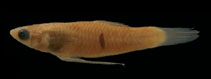
Raios dorsais moles (total) : 8; Raios anais moles: 8 - 11; Vértebras: 32 - 33. Distinguished by the following uniquely derived autapomorphy: typical densely pigmented rectangle like lateral spot located on the 14th or 15th (very rarely 16th) scale of longitudinal line. Can be readily differentiated from its congeners, except Phalloceros tupinamba and Phalloceros aspilos, by the presence a lateral ramus of the female urogenital papilla; female urogenital papilla left turned; large sickle like hook on the gonopodial appendix located in its inner surface and close to its base; and absence of vertical bars along body sides. Phalloceros leptokeras can be distinguished from Phalloceros aspilos by the presence of lateral spot (vs. spot absent). Phalloceros leptokeras can be distinguished from P. tupinamba by the flattened female urogenital papilla (vs. not-flattened in Phalloceros tupinamba) and by the lateral spot densely pigmented, rectangle like, horizontally covering the length corresponding to two or three scales length (vs. normally pigmented, vertically elongated, and horizontally covering the length corresponding to the length of one scale in Phalloceros tupinamba) (Ref. 76852).
Ciclo de vida e comportamento de acasalamento
Maturidade | Reprodução | Desova | Ovos | Fecundidade | Larvas
Lucinda, P.H.F., 2008. Systematics and biogeography of the genus Phalloceros Eigenmann, 1907 (Cyprinodontiformes: Poeciliidae: Poeciliinae), with the description of twenty-one new species. Neotrop. Ichthyol. 6(2):113-158. (Ref. 76852)
Categoria na Lista Vermelha da IUCN (Ref. 130435: Version 2025-2 (Global))
Ameaça para o homem
Harmless
Utilização humana
Ferramentas
Relatórios especiais
Descarregue XML
Fontes da internet
Estimativas baseadas em modelos
Índice de diversidade filogenética (Ref.
82804): PD
50 = 0.5000 [Uniqueness, from 0.5 = low to 2.0 = high].
Bayesian length-weight: a=0.00851 (0.00369 - 0.01962), b=3.15 (2.96 - 3.34), in cm total length, based on LWR estimates for this (Sub)family-body shape (Ref.
93245).
Nível Trófico (Ref.
69278): 3.0 ±0.4 se; based on size and trophs of closest relatives
Resiliência (Ref.
120179): Elevada, tempo mínimo de duplicação da população menor que 15 meses (Preliminary K or Fecundity.).
Vulnerabilidade da pesca (Ref.
59153): Low vulnerability (10 of 100).
🛈