>
Mulliformes (Goatfishes) >
Mullidae (Goatfishes)
Etymology: Parupeneus: Latin, parum, parvum = small + Peneus, the name of a river.
More on author: Bleeker.
Ambiente: milieu / zona climatica / distribuzione batimetrica / gamma di distribuzione
Ecologia
marino associati a barriera corallina; distribuzione batimetrica 1 - 100 m (Ref. 43239). Tropical; 30°N - 25°S
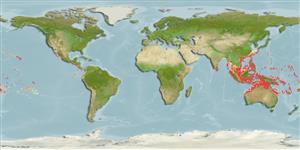
Western Pacific: Moluccas and Philippines to western Samoa, north to the Ryukyu Islands, south to New Caledonia and Tonga; Palau, Caroline and Marshall Islands in Micronesia. Recorded from Shark Bay, Western Australia (Ref. 115274).
Dimensione / Peso / Età
Maturità: Lm ? range ? - ? cm
Max length : 30.0 cm TL maschio/sesso non determinato; (Ref. 9710); common length : 20.0 cm TL maschio/sesso non determinato; (Ref. 48636)
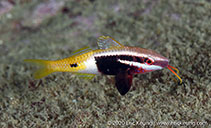
Spine dorsali (totale) : 8; Raggi dorsali molli (totale) : 9; Spine anali: 1; Raggi anali molli: 7. Diagnosis: Pectoral rays 15-16 (usually 15). Gill rakers 6-8 + 20-25 (total 28-32). Body moderately elongate, depth 3.2-3.5 in SL; head length 2.75-3.15 in SL; snout length 1.8-2.0 in HL; barbel length 1.3-1.5 in HL; head and anterior half of body reddish black, posterior half white and yellow with a black spot nearly as large as eye on upper side below rear base of second dorsal fin, followed by small blue spots; a white band from front of snout passing above eye along dorsal part of body, and a second nearly parallel one from corner of mouth to above pectoral fin; caudal fin pale yellow with a broad, dusky lower margin, and often with a small red spot at midbase; barbels red (Ref. 54393).
Body shape (shape guide): fusiform / normal; Cross section: oval.
Adults solitary, juveniles in schools (Ref. 90102). Usually found in the vicinity of coral reefs in protected waters such as bays or lagoons or in deeper outer-reef areas to at least 40 meters (Ref. 54393). Inhabits mixed sand, rubble, and seaweed covered bottoms near coral reefs. Carnivorous, feeds mainly on worms, crustaceans, brittle stars, and small mollusks and heart urchins.
Ciclo vitale e comportamento di accoppiamento
Maturità | Riproduzione | Deposizione | Uova | Fecondità | Larve
Randall, J.E., 2004. Revision of the goatfish genus Parupeneus (Perciformes: Mullidae), with descriptions of two new species. Indo-Pac. Fish. (36):64 p. (Ref. 54393)
Stato della Lista Rossa IUCN (Ref. 130435: Version 2025-2 (Global))
Minaccia per l'uomo
Harmless
Usi umani
Pesca: commerciale; Acquario: Commerciale
Strumenti
Rapporti speciali
Scarica XML
Fonti Internet
Stime basate su modelli
Temperatura preferita (Fonte Biblio.
123201): 24.7 - 28.9, mean 27.6 °C (based on 732 cells).
Indice di diversità filogenetica (Fonte Biblio.
82804): PD
50 = 0.5000 [Uniqueness, from 0.5 = low to 2.0 = high].
Bayesian length-weight: a=0.01349 (0.00825 - 0.02206), b=3.09 (2.96 - 3.22), in cm total length, based on LWR estimates for this species & Genus-body shape (Ref.
93245).
Livello trofico (Fonte Biblio.
69278): 3.4 ±0.39 se; based on food items.
Resilienza (Fonte Biblio.
120179): Medio, tempo minimo di raddoppiamento della popolazione 1.4 - 4.4 anni (Preliminary K or Fecundity.).
Vulnerabilità della pesca (Ref.
59153): Low vulnerability (20 of 100).
🛈
Nutrienti (Ref.
124155): Calcium = 36.8 [18.5, 82.1] mg/100g; Iron = 0.322 [0.164, 0.711] mg/100g; Protein = 17.8 [14.4, 20.8] %; Omega3 = 0.133 [0.075, 0.241] g/100g; Selenium = 57.6 [27.7, 136.4] μg/100g; VitaminA = 200 [40, 841] μg/100g; Zinc = 0.562 [0.338, 1.065] mg/100g (wet weight);