>
Perciformes/Notothenioidei (Icefishes) >
Nototheniidae (Cod icefishes) > Nototheniinae
Etymology: Notothenia: Greek, 'notos', ou; νοτος, ου), from the south + Greek, 'e 'eutheneia',as or 'euthenia', as (ευθενεια, ας; ευθενια, ας), abundance (P. Romero, pers.comm. 01/16); coriiceps: coriiceps from Latin corium skin or leather plus ceps head = skin head or leather head (Ref. 11892).
More on author: Richardson.
Ambiente: milieu / zona climática / intervalo de profundidade / gama de distribuição
Ecologia
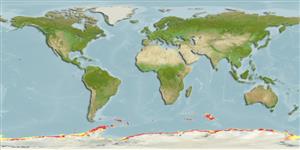
marinhas demersal; intervalo de profundidade 0 - 550 m. Polar; 46°S - 78°S, 180°W - 180°E
Southern Ocean: probably circum-Antarctic on the continental shelf. So far, known from the western Ross Sea, Balleny islands, Adélie Land, Antarctic Peninsula and associated islands, islands of the Scotia Arc to South Georgia, Weddell Sea, Bouvet, and the sub-Antarctic islands of the Indian Ocean sector.
Comprimento na primeira maturidade / Tamanho / Peso / Idade
Maturidade: Lm 36.5 range ? - ? cm
Max length : 62.0 cm TL macho/indeterminado; (Ref. 5179); common length : 50.0 cm TL macho/indeterminado; (Ref. 2121)
Descrição breve
Chaves de identificação | Morfologia | Morfometria
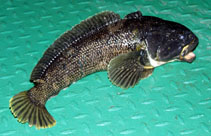
Espinhos dorsais (total) : 4 - 6; Raios dorsais moles (total) : 35 - 38; Raios anais moles: 26 - 30. Wide interorbital space, fewer pectoral rays, lack of scales below the eye (Ref. 11892).
Body shape (shape guide): fusiform / normal.
Most commonly found in less than 200 m (Re. 5179). Stomach contents included
mainly small crustaceans (Amphipoda and Euphausiacea) and seaweeds (Ref. 122792).
Ciclo de vida e comportamento de acasalamento
Maturidade | Reprodução | Desova | Ovos | Fecundidade | Larvas
Dewitt, H.H., P.C. Heemstra and O. Gon, 1990. Nototheniidae. p. 279-331. In O. Gon and P.C. Heemstra (eds.) Fishes of the Southern Ocean. J.L.B. Smith Institute of Ichthyology, Grahamstown, South Africa. (Ref. 5179)
Categoria na Lista Vermelha da IUCN (Ref. 130435: Version 2025-2 (Global))
Ameaça para o homem
Harmless
Utilização humana
Pescarias: de interesse potencial
Ferramentas
Relatórios especiais
Descarregue XML
Fontes da internet
Estimativas baseadas em modelos
Temperatura preferida (Ref.
123201): -1.7 - 2.4, mean -0.6 °C (based on 170 cells).
Índice de diversidade filogenética (Ref.
82804): PD
50 = 0.5312 [Uniqueness, from 0.5 = low to 2.0 = high].
Bayesian length-weight: a=0.00661 (0.00543 - 0.00804), b=3.22 (3.16 - 3.28), in cm total length, based on LWR estimates for this species (Ref.
93245).
Nível Trófico (Ref.
69278): 2.8 ±0.35 se; based on food items.
Resiliência (Ref.
120179): Baixo, tempo mínimo de duplicação da população 4,5 - 14 anos (Assuming tm>4).
Vulnerabilidade da pesca (Ref.
59153): High vulnerability (60 of 100).
🛈
Vulnerabilidade climática (Ref.
125649): Moderate to high vulnerability (50 of 100).
🛈
Nutrientes (Ref.
124155): Calcium = 20.8 [12.1, 47.6] mg/100g; Iron = 0.412 [0.189, 0.797] mg/100g; Protein = 18 [16, 20] %; Omega3 = 0.326 [0.178, 0.568] g/100g; Selenium = 18.9 [7.9, 43.2] μg/100g; VitaminA = 9.04 [2.05, 41.45] μg/100g; Zinc = 0.491 [0.330, 0.740] mg/100g (wet weight);