>
Cichliformes (Cichlids, convict blennies) >
Cichlidae (Cichlids) > Pseudocrenilabrinae
Etymology: Neolamprologus: Greek, neos = new + Greek,lampros = torch + Greek, lagos = hare (Ref. 45335).
More on author: Boulenger.
Ambiente: milieu / zona climatica / distribuzione batimetrica / gamma di distribuzione
Ecologia
; acqua dolce benthopelagico, usually 6 - 12 m (Ref. 118184). Tropical; 23°C - 25°C (Ref. 2060); 6°S - 9°S
Africa: Endemic to the south end of Lake Tanganyika.
Dimensione / Peso / Età
Maturità: Lm ? range ? - ? cm
Max length : 12.0 cm TL maschio/sesso non determinato; (Ref. 5667); 10.0 cm TL (female)
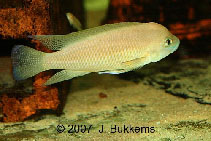
Usually solitary although many individuals may be observed at one time. Feeds on small snails that specifically live on the biocover (Chytra kirki, Spekia zonata, Paramelania demoni and Tanganycia rufofilosa). Also feeds on the eggs of the killifish, Lamprichthys tanganicanus. Leaves the rocky biotope to breed in the sandy bottom (Ref. 7343).
Ciclo vitale e comportamento di accoppiamento
Maturità | Riproduzione | Deposizione | Uova | Fecondità | Larve
Spawns in caves, both parents care for the young.
Maréchal, C. and M. Poll, 1991. Neolamprologus. p. 274-294. In J. Daget, J.-P. Gosse, G.G. Teugels and D.F.E. Thys van den Audenaerde (eds.) Check-list of the freshwater fishes of Africa (CLOFFA). ISNB, Brussels; MRAC, Tervuren; and ORSTOM, Paris. Vol. 4. (Ref. 5667)
Stato della Lista Rossa IUCN (Ref. 130435: Version 2025-2 (Global))
Minaccia per l'uomo
Harmless
Usi umani
Pesca: commerciale; Acquario: Commerciale
Strumenti
Rapporti speciali
Scarica XML
Fonti Internet
Stime basate su modelli
Indice di diversità filogenetica (Fonte Biblio.
82804): PD
50 = 0.5000 [Uniqueness, from 0.5 = low to 2.0 = high].
Bayesian length-weight: a=0.01905 (0.00846 - 0.04293), b=3.01 (2.82 - 3.20), in cm total length, based on LWR estimates for this (Sub)family-body shape (Ref.
93245).
Livello trofico (Fonte Biblio.
69278): 3.5 ±0.56 se; based on food items.
Resilienza (Fonte Biblio.
120179): Alto, tempo minimo di raddoppiamento della popolazione meno di 15 mesi (Preliminary K or Fecundity.).
Vulnerabilità della pesca (Ref.
59153): Low vulnerability (10 of 100).
🛈