>
Lophiiformes (Anglerfishes) >
Neoceratiidae (Toothed seadevils)
Etymology: Neoceratias: Named by Pappenheim (1914:198) to signify a new kind of ceratiid-like anglerfish, at the time expressing uncertainty of its position within the suborder but finding great similarity with the Ceratiidae. (Ref. 86949).
Ambiente: milieu / zona climática / intervalo de profundidade / gama de distribuição
Ecologia
marinhas demersal; intervalo de profundidade 0 - 1200 m (Ref. 58302). Deep-water
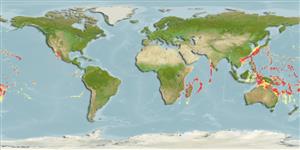
Western Central Pacific.
Tamanho / Peso / Idade
Maturidade: Lm ? range ? - ? cm
Max length : 6.0 cm TL macho/indeterminado; (Ref. 557)
Descrição breve
Chaves de identificação | Morfologia | Morfometria
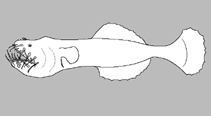
Raios dorsais moles (total) : 10 - 13; Raios anais moles: 10 - 13. Metamorphosed females distinguished by the following characteristics: lacks illicium and second cephalic spine, as well as cranial trough, within which pterygiophore of illicium lies in all other female ceratioids; broad and roughly rectangular shaped frontals; absence of metapterygoid and mesopterygoid; usually short and nearly straight preopercle; usually thick and well developed premaxillae and dentaries, with rounded edges; presence of a pair of prominent nasal papillae on snout; inner margin of jaws bearing single inner row of small immobile teeth; outer margin bears 2-3 series of long hinged teeth, each with tiny distal hook; dorsal and anal fins mounted on prominent bases; presence of supraethmoid; frontals without ventromedial extensions, meet on midline; presence of parietals; conical shaped sphenotics, without distal spine; presence of pterosphenoid; hyomandibula with single head; 2 hypohyals and 6 (2+4), rarely 5 (1+4), branchiostegal rays; bifuctaed and very much reduced opercle; reduced subopercle, long and narrow, as long as or slightly longer than lower fork of opercle, without posterior notch; ventral part without spine or projection on anterior margin; quadrate, articular, angular and preopercular spines absent; jaws subequal, lower extending anteriorly beyond upper; lower jaw lacking symphisial spine; absence postmaxillary process of premaxilla and anterior-maximandibular ligament; absence of first, second and fourth pharyngobranchial, third is well developed and toothed; single ossified hypobranchial; absence of ossified basibranchials; absence of epibranchial and ceratobranchial; epurals absent; deeply notched posterior margin of hypural plate; pterygiophore of illicium fully embedded in skin of head; esca absent; coracoid lacking posteroventral process; 3 pectoral radials; small and cylindrical pelvic bones, without distal expansion; dorsal fin rays 10-13; anal fin rays 10-13; pectoral fin rays 12-15; pelvic fins absent (Ref. 86949).
Meso- (Ref 58302) and bathypelagic (Ref. 7300, 75154). Females with long movable teeth outside jaws. Mature males parasitic on females.
Ciclo de vida e comportamento de acasalamento
Maturidade | Reprodução | Desova | Ovos | Fecundidade | Larvas
Nelson, J.S., 1984. Fishes of the world. 2nd edition. John Wiley & Sons, Inc., New York. 523 p. (Ref. 245)
Categoria na Lista Vermelha da IUCN (Ref. 130435: Version 2025-2 (Global))
Ameaça para o homem
Harmless
Utilização humana
Pescarias: sem interesse
Ferramentas
Relatórios especiais
Descarregue XML
Fontes da internet
Estimativas baseadas em modelos
Temperatura preferida (Ref.
123201): 8.3 - 20.1, mean 13 °C (based on 250 cells).
Índice de diversidade filogenética (Ref.
82804): PD
50 = 1.5000 [Uniqueness, from 0.5 = low to 2.0 = high].
Bayesian length-weight: a=0.00389 (0.00180 - 0.00842), b=3.12 (2.94 - 3.30), in cm total length, based on all LWR estimates for this body shape (Ref.
93245).
Nível Trófico (Ref.
69278): 3.5 ±0.5 se; based on size and trophs of closest relatives
Vulnerabilidade da pesca (Ref.
59153): Low vulnerability (10 of 100).
🛈
Nutrientes (Ref.
124155): Calcium = 77.4 [30.7, 210.4] mg/100g; Iron = 0.678 [0.288, 1.403] mg/100g; Protein = 17.6 [15.0, 20.7] %; Omega3 = 0.571 [0.185, 1.583] g/100g; Selenium = 10.5 [3.4, 27.0] μg/100g; VitaminA = 69.1 [14.1, 370.3] μg/100g; Zinc = 0.611 [0.352, 1.033] mg/100g (wet weight);