Classificazione / Nomi
Nomi Comuni | Sinonimi | Catalog of Fishes(Genere, Specie) | ITIS | CoL | WoRMS | Cloffa
>
Siluriformes (Catfishes) >
Ariidae (Sea catfishes) > Ariinae
Eponymy: Dr Stephen Hamar Midgley (1918–2014) was an amateur ichthyologist and limnologist whose honorary doctorate was awarded by the University of Queensland (1994). [...] (Ref. 128868), visit book page.
Ambiente: milieu / zona climatica / distribuzione batimetrica / gamma di distribuzione
Ecologia
; acqua dolce; salmastro benthopelagico. Tropical
Oceania: northern Australia.
Dimensione / Peso / Età
Maturità: Lm ? range ? - ? cm
Max length : 140 cm SL maschio/sesso non determinato; (Ref. 44894); common length : 50.0 cm SL maschio/sesso non determinato; (Ref. 44894)
Breve descrizione
Chiavi di identificazione | Morfologia | Morfometria
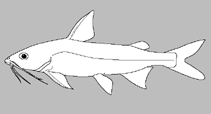
Raggi anali molli: 16 - 19; Vertebre: 55 - 57. Eye size 12.9-21.8% HL. Because of its similarity to A. paucus, the remaining diagnosis refers to both A. midgleyi and A. paucus: a sleek body; strong jaws; jaws upturned slightly at symphyses, mouth broad; snout truncate in profile; head oblong, its width averaging 66% HL. Supraoccipital process narrow with parallel margins. Numerous fine, sharp teeth on palate in transverse band of four oblong groups. No rakers on posterior aspect of gill arches. Barbels thin and short, rarely reaching beyond pectoral fin base and less than 25% SL (Ref. 40908).
Inhabits in lakes, billabongs, rivers and to a lesser extent brackish estuaries and the tidal portion of rivers. Found in clear or turbid fresh water reservoirs and waterholes. Water is typically warm (23-35°C), with pH between 7.0-8.7 (Ref. 44894). Feeds mainly on fishes, prawns and crayfish. Various arthropods are also consumed. Breeds early in the wet season, sometimes extending into the late wet (November to March). Eggs are incubated orally by the male for 5-6 weeks; brooding males form groups in deeper water. Juveniles grow quickly, attaining 20-30 centimeters by the end of the first year, and sexual maturity is reached after 3 years. An excellent eating fish, rapidly growing in popularity (Ref. 44894).
Ciclo vitale e comportamento di accoppiamento
Maturità | Riproduzione | Deposizione | Uova | Fecondità | Larve
Allen, G.R., 1989. Freshwater fishes of Australia. T.F.H. Publications, Inc., Neptune City, New Jersey. (Ref. 5259)
Stato della Lista Rossa IUCN (Ref. 130435: Version 2025-2 (Global))
Minaccia per l'uomo
Traumatogenic (Ref. 58010)
Usi umani
Strumenti
Rapporti speciali
Scarica XML
Fonti Internet
Stime basate su modelli
Indice di diversità filogenetica (Fonte Biblio.
82804): PD
50 = 0.5312 [Uniqueness, from 0.5 = low to 2.0 = high].
Bayesian length-weight: a=0.00468 (0.00245 - 0.00892), b=3.13 (2.96 - 3.30), in cm total length, based on LWR estimates for this (Sub)family-body shape (Ref.
93245).
Livello trofico (Fonte Biblio.
69278): 4.1 ±0.61 se; based on food items.
Resilienza (Fonte Biblio.
120179): Molto basso, tempo minimo di raddoppiamento della popolazione più di 14 anni (Preliminary K or Fecundity.).
Vulnerabilità della pesca (Ref.
59153): Very high vulnerability (90 of 100).
🛈