>
Holocentriformes (Squirrelfishes, soldierfishes) >
Holocentridae (Squirrelfishes, soldierfishes) > Myripristinae
Etymology: Myripristis: Greek, myros, -ou = male of morey eel + Greek, pristis = saw (Ref. 45335).
Eponymy: Jacobus is a latinization of James, and refers to the fish’s local name Frère-Jacques (Brother Jim) in Martinique, which is the type locality. (Ref. 128868), visit book page.
More on author: Cuvier.
Ambiente: milieu / zona climática / intervalo de profundidade / gama de distribuição
Ecologia
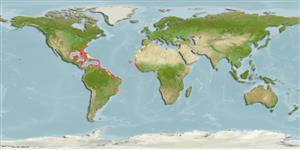
marinhas associadas(os) a recifes; intervalo de profundidade 0 - 210 m (Ref. 115215), usually 2 - 35 m (Ref. 40849). Subtropical; 37°N - 23°S, 98°W - 9°E
Western Atlantic: North Carolina (USA), Bahamas and northern Gulf of Mexico to Brazil; throughout the West Indies and the Caribbean Sea (Ref. 3724). Eastern Atlantic: St. Paul's Rocks (Ref. 13121), Cape Verde, Principe, Ascension and St. Helena islands (Ref. 6537).
Tamanho / Peso / Idade
Maturidade: Lm ? range ? - ? cm
Max length : 25.0 cm TL macho/indeterminado; (Ref. 5217); common length : 20.0 cm TL macho/indeterminado; (Ref. 5217)
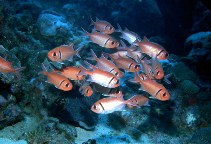
Espinhos dorsais (total) : 11; Raios dorsais moles (total) : 14; Espinhos anais: 4; Raios anais moles: 13 - 14. Soft dorsal and anal fins covered with scales (Ref. 13608). Dark brown vertical bar runs along gill opening to pectoral fin (Ref. 26938). Body deep, compressed and robust (Ref. 37108). Body reddish above, paling to silvery below. Spinous dorsal fin with red and white markings. Edges of all fins are white. Preopercular spine not prominent. Lobes of caudal, soft dorsal and anal fins pointed (Ref. 7251).
Body shape (shape guide): fusiform / normal.
Found from shallow coral reefs to offshore deeper waters (Ref. 3724). A nocturnal species aggregating around coral reefs and deeper rocky reefs (Ref. 3724). Feeds mainly on planktonic organisms (Ref. 3724). Occasionally found swimming upside down (Ref. 9710). Marketed fresh but not popular as a food fish (Ref. 5217).
Ciclo de vida e comportamento de acasalamento
Maturidade | Reprodução | Desova | Ovos | Fecundidade | Larvas
Robins, C.R. and G.C. Ray, 1986. A field guide to Atlantic coast fishes of North America. Houghton Mifflin Company, Boston, U.S.A. 354 p. (Ref. 7251)
Categoria na Lista Vermelha da IUCN (Ref. 130435: Version 2025-2 (Global))
Ameaça para o homem
Harmless
Utilização humana
Pescarias: pouco comercial; Aquário: Espécies comerciais
Ferramentas
Relatórios especiais
Descarregue XML
Fontes da internet
Estimativas baseadas em modelos
Temperatura preferida (Ref.
123201): 23.6 - 28, mean 26.6 °C (based on 652 cells).
Índice de diversidade filogenética (Ref.
82804): PD
50 = 0.5000 [Uniqueness, from 0.5 = low to 2.0 = high].
Bayesian length-weight: a=0.01413 (0.00793 - 0.02517), b=3.01 (2.86 - 3.16), in cm total length, based on LWR estimates for this species & Genus-body shape (Ref.
93245).
Nível Trófico (Ref.
69278): 3.4 ±0.2 se; based on diet studies.
Resiliência (Ref.
120179): Elevada, tempo mínimo de duplicação da população menor que 15 meses (Preliminary K or Fecundity.).
Vulnerabilidade da pesca (Ref.
59153): Low vulnerability (15 of 100).
🛈
Nutrientes (Ref.
124155): Calcium = 39.6 [16.0, 105.5] mg/100g; Iron = 0.697 [0.277, 1.494] mg/100g; Protein = 19.2 [17.9, 20.3] %; Omega3 = 0.284 [0.111, 0.698] g/100g; Selenium = 21.1 [10.5, 42.4] μg/100g; VitaminA = 42.4 [14.1, 136.7] μg/100g; Zinc = 0.874 [0.531, 1.408] mg/100g (wet weight);