>
Acropomatiformes (Oceanic basses) >
Creediidae (Sandburrowers)
Etymology: Myopsaron: Name from the Greek words 'mys' meaning mouse and 'opsaron' for a little fish, referring to its unique globular-shaped fleshy extension at tip of upper jaw, resembling the nose of mouse; nelsoni: Named for J. S. Nelson, for his great contribution to our knowledge about taxonomy and systematics of the creediine fishes.
Eponymy: Dr Joseph Schiesser ‘Tiger Joe’ Nelson (1937–2011) was an American ichthyologist, aquarist and keen amateur astronomer. [...] (Ref. 128868), visit book page.
Ambiente: milieu / zona climatica / distribuzione batimetrica / gamma di distribuzione
Ecologia
marino pelagic-neritic; distribuzione batimetrica 51 - 99 m (Ref. 84004). Subtropical
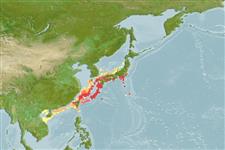
Northwest Pacific: endemic to Ogasawara Islands, Japan.
Dimensione / Peso / Età
Maturità: Lm ? range ? - ? cm
Max length : 3.6 cm SL maschio/sesso non determinato; (Ref. 84004)
Breve descrizione
Chiavi di identificazione | Morfologia | Morfometria
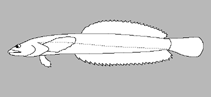
Raggi dorsali molli (totale) : 14 - 16; Raggi anali molli: 16 - 18; Vertebre: 43 - 45. This species is unique in having the following characters: a globular fleshy extension at tip of upper jaw; lateral line divided into 2 parts, with 3 (rarely 2 or 4) grooved scales in the anterior series and 33-35 pored scales with distinct posterior lobe in the posterior series; higher counts of precaudal vertebrae than caudal vertebrae (24-26 + 18-21 = 43-45); edentate premaxilla; D 14-16; A 16-18; dorsal- and anal-fin rays 30-34, both fins restricted to posterior half of body; anal-fin origin below first to third dorsal-fin rays; pelvic-fin I,3-4 (almost always I,3); fourth pectoral- and first pelvic-fin rays greatly elongated and filamentous in male; all dorsal-, anal-, pectoral- and pelvic-fin segmented rays unbranched; caudal-fin rays 9 branched; anal-fin pterygiophores 1 (rarely two) anterior to first haemal spine; vomer and palatine teeth absent, 1 to 3 minute conical teeth on middle of dentary; epurals 2; both anterior and posterior nares pore-like; suborbital skin fold discontinuous at midway; infraorbital canal shortly interrupted below eye; mandibular canal not joined with preopercular canal (Ref. 84004).
Body shape (shape guide): eel-like.
Collected by sledge nets from flat sandy bottoms off its type locality (Ref. 84004).
Ciclo vitale e comportamento di accoppiamento
Maturità | Riproduzione | Deposizione | Uova | Fecondità | Larve
Shibukawa, K., 2010. Myopsaron nelsoni, a new genus and species of sandburrowers (Perciformes: Trichonotidae: Creediinae) from the Ogasawara Islands, Japan. Bull. Natl. Mus. Nat. Sci., Ser. A, (Suppl. 4):49-66. (Ref. 84004)
Stato della Lista Rossa IUCN (Ref. 130435: Version 2025-2 (Global))
Minaccia per l'uomo
Harmless
Usi umani
Strumenti
Rapporti speciali
Scarica XML
Fonti Internet
Stime basate su modelli
Indice di diversità filogenetica (Fonte Biblio.
82804): PD
50 = 1.0000 [Uniqueness, from 0.5 = low to 2.0 = high].
Bayesian length-weight: a=0.00389 (0.00180 - 0.00842), b=3.12 (2.94 - 3.30), in cm total length, based on all LWR estimates for this body shape (Ref.
93245).
Livello trofico (Fonte Biblio.
69278): 3.2 ±0.4 se; based on size and trophs of closest relatives
Vulnerabilità della pesca (Ref.
59153): Low vulnerability (10 of 100).
🛈