Elasmobranchii (tubarões e raias) (sharks and rays) >
Myliobatiformes (Stingrays) >
Myliobatidae (Eagle and manta rays)
Etymology: Myliobatis: Greek, mylo = mill + Greek, + Greek, batis,-idos = a ray (Raja sp.) (Ref. 45335).
More on author: Linnaeus.
Ambiente: milieu / zona climática / intervalo de profundidade / gama de distribuição
Ecologia
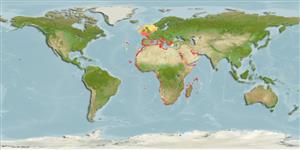
marinhas; estuarina bentopelágico; intervalo de profundidade 1 - 300 m (Ref. 4440). Subtropical; 60°N - 36°S, 32°W - 58°E
Eastern Atlantic: Madeira, Morocco and the Canary Islands north to the western coasts of Ireland and British Isles and the southwestern North Sea, south to Natal, South Africa (western Indian Ocean); throughout the Mediterranean.
Comprimento na primeira maturidade / Tamanho / Peso / Idade
Maturidade: Lm ?, range 60 - ? cm
Max length : 183 cm WD macho/indeterminado; (Ref. 4440); peso máx. Publicado: 14.5 kg (Ref. 40637)
Descrição breve
Chaves de identificação | Morfologia | Morfometria
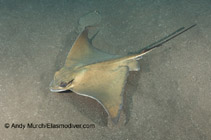
A plain eagleray with a short, rounded snout; disc with broadly angular corners, and upper or lower jaw usually with 7 rows of plate-like teeth (Ref. 5578). Brown or blackish dorsally, white ventrally (Ref. 5578). No caudal fin (Ref. 5578).
Body shape (shape guide): other.
Found in shallow lagoons (Ref. 3965), bays and estuaries; also offshore down to at least 95 m (Ref. 5578). Often found in groups (Ref. 5578). Feeds on benthic crustaceans, mollusks and fish. Ovoviviparous (Ref. 50449). Gestation period of 6-8 months, the females give birth to 3-7 young (Ref. 35388). Caught by shore and ski-boat anglers, usually released after capture (Ref. 5578). Flesh is highly esteemed (Ref. 3965).
Exhibit ovoviparity (aplacental viviparity), with embryos feeding initially on yolk, then receiving additional nourishment from the mother by indirect absorption of uterine fluid enriched with mucus, fat or protein through specialised structures (Ref. 50449).
McEachran, J.D. and B. Séret, 1990. Myliobatididae. p. 67-70. In J.C. Quero, J.C. Hureau, C. Karrer, A. Post and L. Saldanha (eds.) Check-list of the fishes of the eastern tropical Atlantic (CLOFETA). JNICT, Lisbon; SEI, Paris; and UNESCO, Paris. Vol. 1. (Ref. 4440)
Categoria na Lista Vermelha da IUCN (Ref. 130435: Version 2025-2 (Global))
Ameaça para o homem
Harmless
Utilização humana
Pescarias: pouco comercial; peixe desportivo: sim
Ferramentas
Relatórios especiais
Descarregue XML
Fontes da internet
Estimativas baseadas em modelos
Temperatura preferida (Ref.
123201): 11.7 - 19.8, mean 15.2 °C (based on 318 cells).
Índice de diversidade filogenética (Ref.
82804): PD
50 = 0.5002 [Uniqueness, from 0.5 = low to 2.0 = high].
Bayesian length-weight: a=0.00389 (0.00124 - 0.01219), b=3.08 (2.83 - 3.33), in cm total length, based on LWR estimates for this (Sub)family-body shape (Ref.
93245).
Nível Trófico (Ref.
69278): 3.6 ±0.54 se; based on food items.
Resiliência (Ref.
120179): Muito baixo, tempo mínimo de duplicação da população maior que 14 anos (Fec=3).
Vulnerabilidade da pesca (Ref.
59153): Very high vulnerability (83 of 100).
🛈
Vulnerabilidade climática (Ref.
125649): Moderate to high vulnerability (47 of 100).
🛈
Nutrientes (Ref.
124155): Calcium = 6.54 [0.80, 118.48] mg/100g; Iron = 0.508 [0.046, 6.020] mg/100g; Protein = 20.4 [15.1, 25.6] %; Omega3 = 0.205 [0.068, 0.558] g/100g; Selenium = 36.1 [6.7, 193.9] μg/100g; VitaminA = 3.95 [0.36, 41.63] μg/100g; Zinc = 0.492 [0.030, 5.489] mg/100g (wet weight);