Taxonomic Remarks
Provisionally valid species. When recognized, mainly considered as a subspecies of Merluccius gayi (Guichenot, 1848). Still more studies are needed to characterize it (March 2021).
Entorno: milieu / zona climática / rango de profundidad / gama de distribución
Ecología
marino batidemersal; oceanodromo (Ref. 51243); rango de profundidad 50 - 500 m (Ref. 1371). Deep-water; 4°S - 14°S
Southeast Pacific: off the coast of Peru, from Paita southward to Huarmey.
Longitud en la primera madurez / Tamaño / Peso / Edad
Madurez: Lm 35.0 range ? - ? cm
Max length : 68.0 cm TL macho / no sexado; (Ref. 1371); 115.0 cm TL (female); common length : 50.0 cm TL macho / no sexado; (Ref. 1371); edad máxima reportada: 13 años (Ref. 9722)
Descripción breve
Claves de identificación | Morfología | Morfometría
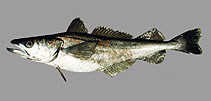
Espinas dorsales (total) : 1; Radios blandos dorsales (total) : 45 - 54; Espinas anales: 0; Radios blandos anales: 36 - 42. Caudal fin margin usually concave. Color is silvery on back, silvery whitish on belly. M. gayi gayi and M. gayi peruanus differ by the total number of vertebrae, total number of gill rakers and relative length of head (Ref. 1371).
Body shape (shape guide): elongated.
Occurs from the shallow continental shelf to the upper continental slope (Ref. 1371). Sometimes found off the bottom or in midwater (Ref. 1371). Marketed fresh and frozen and also used for fishmeal (Ref. 1371).
Ciclo vital y comportamiento de apareamiento
Madurez | Reproducción | Puesta | Huevos | Fecundidad | Larva
Espino, M., R. Castillo and F. Fernandez, 1995. Biology and fisheries of Peruvian hake (M. gayi peruanus). p. 339-363. In J. Alheit and T. J. Pitcher (eds.) Hake:biology, fisheries and markets. Chapmanand Hall, London, 478 p. (Ref. 9718)
Situación en la Lista Roja de la UICN (Ref. 130435: Version 2025-2 (Global))
Amenaza para el ser humano
Harmless
Usos humanos
Pesquerías: muy comercial
Herramientas
Informes especiales
Descargar XML
Fuentes de Internet
Estimaciones basadas en modelos
Índice de diversidad filogenética (Referencia
82804): PD
50 = 0.5000 [Uniqueness, from 0.5 = low to 2.0 = high].
Bayesian length-weight: a=0.00525 (0.00256 - 0.01076), b=3.09 (2.92 - 3.26), in cm total length, based on LWR estimates for this species & Genus-body shape (Ref.
93245).
Nivel trófico (Referencia
69278): 4.4 ±0.6 se; based on diet studies.
Resiliencia (Referencia
120179): Medio, población duplicada en un tiempo mínimo de 1.4-4.4 años (K=0.19-0.21; tmax=13).
Vulnerabilidad pesquera (Ref.
59153): Moderate to high vulnerability (54 of 100).
🛈
Vulnerabilidad climática (Ref.
125649): Very high vulnerability (90 of 100).
🛈
Nutrientes (Ref.
124155): Calcium = 10.9 [5.5, 38.6] mg/100g; Iron = 0.326 [0.063, 0.892] mg/100g; Protein = 17 [16, 18] %; Omega3 = 0.141 [0.074, 0.262] g/100g; Selenium = 22.4 [10.1, 50.5] μg/100g; VitaminA = 14 [3, 62] μg/100g; Zinc = 0.245 [0.168, 0.379] mg/100g (wet weight);