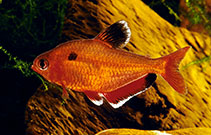
Classificazione / Nomi
Nomi Comuni | Sinonimi | Catalog of Fishes(Genere, Specie) | ITIS | CoL | WoRMS | Cloffa
>
Characiformes (Characins) >
Acestrorhamphidae (American tetras) > Megalamphodinae
Etymology: Megalamphodus: Greek, megas, megalos = great + Greek, amphi = in both sides + Greek, odous = teeth (Ref. 45335).
More on author: Steindachner.
Taxonomic Remarks
Ornamental species. See Weitzman & Palmer (1997a,b) for notes on the taxonomy and synonym.
Ambiente: milieu / zona climatica / distribuzione batimetrica / gamma di distribuzione
Ecologia
; acqua dolce benthopelagico; pH range: 5.0 - 7.8; dH range: 10 - 25. Tropical; 22°C - 26°C (Ref. 12468)
South America: Amazon, Guaporé and Paraguay River basins.
Lunghezza alla prima maturità / Dimensione / Peso / Età
Maturità: Lm 2.1 range ? - ? cm
Max length : 4.0 cm SL maschio/sesso non determinato; (Ref. 81048)
A gregarious species which positions itself near the surface between the stems of emerging plants. It is frequently found in stagnant waters. They are generally peaceful, but when there are too many of them during feeding, they bite each other's fins (Ref. 12225). They feed on worms, crustaceans, insects and plants (Ref. 7020). Oviparous (Ref. 205). Migratory behaviour is undetermined (Ref. 126106). This species is part of a complex of `blood' tetras, hybrids of which are commonly offered in the aquarium trade. Aquarium keeping: aggressive; in groups of 5 or more individuals; minimum aquarium size 60 cm (Ref. 51539).
Ciclo vitale e comportamento di accoppiamento
Maturità | Riproduzione | Deposizione | Uova | Fecondità | Larve
Oviparous (Ref. 205). In captivity, spawning is preceded by vigorous driving by the male during the early hours of the day and eggs mostly sink to the bottom (Ref. 7020).
Weitzman, S.H. and L. Palmer, 1997. A new species of Hyphessobrycon (Teleostei: Characidae) from Neblina region of Venezuela and Brazil, with comments on the putative 'rosy tetra clade'. Ichthyol. Explor. Freshwat. 7(3-4):209-242. (Ref. 13676)
Stato della Lista Rossa IUCN (Ref. 130435: Version 2025-2 (Global))
Minaccia per l'uomo
Harmless
Usi umani
Pesca: elevato interesse commerciale; Acquario: elevato interesse commerciale
Strumenti
Rapporti speciali
Scarica XML
Fonti Internet
Stime basate su modelli
Indice di diversità filogenetica (Fonte Biblio.
82804): PD
50 = 0.5002 [Uniqueness, from 0.5 = low to 2.0 = high].
Bayesian length-weight: a=0.01349 (0.00692 - 0.02631), b=3.14 (2.97 - 3.31), in cm total length, based on LWR estimates for this species & (Sub)family-body (Ref.
93245).
Livello trofico (Fonte Biblio.
69278): 3.1 ±0.38 se; based on food items.
Resilienza (Fonte Biblio.
120179): Alto, tempo minimo di raddoppiamento della popolazione meno di 15 mesi (Preliminary K or Fecundity.).
Vulnerabilità della pesca (Ref.
59153): Low vulnerability (10 of 100).
🛈