Ambiente: milieu / zona climática / intervalo de profundidade / gama de distribuição
Ecologia
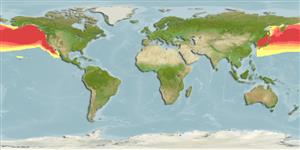
marinhas batipelágico; intervalo de profundidade 16 - 1267 m (Ref. 96339). Deep-water; 66°N - 21°N, 128°E - 109°W
North Pacific: Bering Sea to Japan, and Baja California, Mexico.
Tamanho / Peso / Idade
Maturidade: Lm ? range ? - ? cm
Max length : 15.0 cm TL macho/indeterminado; (Ref. 87380)
Descrição breve
Chaves de identificação | Morfologia | Morfometria
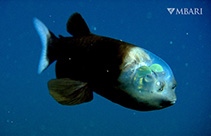
Espinhos dorsais (total) : 0; Raios dorsais moles (total) : 11; Espinhos anais: 0; Raios anais moles: 14. This species' most striking feature is the transparent, cowl-like shield that covers the top of the head, and its prominent tubular eyes within. The shield is a tough, flexible integument that attaches to the dorsal and medial scales behind the head, and to the broad, transparent subocular bones that protect the eyes laterally. The fluid-field chamber found beneath the shield surrounds and protects the eyes with vivid green lenses. The tubular eyes of this fish can look forward as well as upward (with maximum arc of rotation observed about 75 degrees). The morphology of the eyes apparently allow at least two feeding modes: (1) with body horizontal and with eyes directed upward, it can spot food against lighted waters above, it pivots its body to bring the mouth up for ingestion while eyes are locked on target, rotating from dorsal to rostral relative to the body; and (2) with body horizontal, eyes rotate dorsal to rostral while tracking the path of descending food until it reaches the level of the mouth (Ref. 87379). Adipose at the base of the caudal peduncle (Ref. 6885). Adults dark brown (Ref. 6885).
A solitary fish, occurring at lower mesopelagic depths beneath temperate and subarctic waters. Caught by midwater trawl nets in areas with bottom depths of 1600-3600 m. Stomach contents include cnidarian remains, however, its visceral anatomy suggests diets of mixed zooplankton, including both gelatinous and crustacean prey and siphonophore tentacles and nematocysts (Ref. 87379). Uncommon species (Ref. 6885). Oviparous, with planktonic larvae (Ref. 35626). A photo of a 15 cm long fish shown at http://www.newscientist.com/gallery/new-species/9.
Ciclo de vida e comportamento de acasalamento
Maturidade | Reprodução | Desova | Ovos | Fecundidade | Larvas
Eschmeyer, W.N., E.S. Herald and H. Hammann, 1983. A field guide to Pacific coast fishes of North America. Boston (MA, USA): Houghton Mifflin Company. xii+336 p. (Ref. 2850)
Categoria na Lista Vermelha da IUCN (Ref. 130435: Version 2025-2 (Global))
Ameaça para o homem
Harmless
Utilização humana
Pescarias: bycatch
Ferramentas
Relatórios especiais
Descarregue XML
Fontes da internet
Estimativas baseadas em modelos
Temperatura preferida (Ref.
123201): 0.6 - 6.8, mean 3.7 °C (based on 175 cells).
Índice de diversidade filogenética (Ref.
82804): PD
50 = 1.0000 [Uniqueness, from 0.5 = low to 2.0 = high].
Bayesian length-weight: a=0.01122 (0.00514 - 0.02450), b=3.04 (2.87 - 3.21), in cm total length, based on all LWR estimates for this body shape (Ref.
93245).
Nível Trófico (Ref.
69278): 3.6 ±0.1 se; based on size and trophs of closest relatives
Resiliência (Ref.
120179): Elevada, tempo mínimo de duplicação da população menor que 15 meses (Preliminary K or Fecundity.).
Vulnerabilidade da pesca (Ref.
59153): Low vulnerability (10 of 100).
🛈