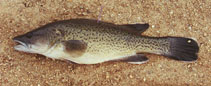
Ambiente: milieu / zona climática / intervalo de profundidade / gama de distribuição
Ecologia
; Água doce demersal; não migratória. Temperate; 18°C - 28°C (Ref. 2060); 32°S - 36°S
Oceania: Murray-Darling basin, New South Wales, Australia - Mitta Mitta River, upper Murray River (Tintaldra, Mulwala area-Ref. 2906), MurrumbidgeeRiver, Cataract Dam (NepeanRiver), also in the Macquarie River (Ref. 2906). Stocked population in Seven Creeks River and Glenbawm Dam (HunterRiver) (Ref. 2906); also in Lake Sambell (Ref. 6071).
Tamanho / Peso / Idade
Maturidade: Lm ? range ? - ? cm
Max length : 85.0 cm SL macho/indeterminado; (Ref. 44894); common length : 50.0 cm SL macho/indeterminado; (Ref. 5259); peso máx. Publicado: 16.0 kg (Ref. 26161)
Occur from riffle and boulder areas in relatively small upland streams to larger deeper rivers with sand and clay substrates and submerged timber and snags (Ref. 26161, 44894). Found in still and fast-flowing waters (14°-28°C), usually over bedrock, boulder and gravel bottoms of streams. Large fish confined to deep holes between falls and rapids, while small ones are found among boulders. Feed on insects, crayfish, shrimp, and small fishes; cannibalism occurs. Spawn in spring and early summer. The large, adhesive eggs are laid on hard surfaces. Hatching occurs in 5-10 days at 20°C. Sexual maturity is attained at 3-5 years of age (Ref. 44894). Territorial juveniles. Infected by parasitic protozoan Chilodonella cyprini; susceptible to `ich' & Saprolegnia infections. Protected by law and its capture is strictly prohibited. Known to hybridize with closely related Murray (Ref. 44894).
Ciclo de vida e comportamento de acasalamento
Maturidade | Reprodução | Desova | Ovos | Fecundidade | Larvas
The demersal and adhesive eggs (2.5-3.6 mm in diameter) are laid onto a hard surface. Hatching starts 5 days after fertilization and continues for up to 10 days at around 20°C.
Paxton, J.R., D.F. Hoese, G.R. Allen and J.E. Hanley, 1989. Pisces. Petromyzontidae to Carangidae. Zoological Catalogue of Australia, Vol. 7. Australian Government Publishing Service, Canberra, 665 p. (Ref. 7300)
Categoria na Lista Vermelha da IUCN (Ref. 130435: Version 2025-2 (Global))
Utilização humana
Pescarias: de interesse potencial; Aquacultura: experimental; peixe desportivo: sim; Aquário: Espécies comerciais
Ferramentas
Relatórios especiais
Descarregue XML
Fontes da internet
Estimativas baseadas em modelos
Índice de diversidade filogenética (Ref.
82804): PD
50 = 0.5625 [Uniqueness, from 0.5 = low to 2.0 = high].
Bayesian length-weight: a=0.01047 (0.00397 - 0.02763), b=3.01 (2.78 - 3.24), in cm total length, based on LWR estimates for this (Sub)family-body shape (Ref.
93245).
Nível Trófico (Ref.
69278): 4.0 ±0.60 se; based on food items.
Resiliência (Ref.
120179): Muito baixo, tempo mínimo de duplicação da população maior que 14 anos (Preliminary K or Fecundity.).
Vulnerabilidade da pesca (Ref.
59153): High vulnerability (62 of 100).
🛈