>
Clupeiformes (Herrings) >
Engraulidae (Anchovies) > Engraulinae
Etymology: Lycengraulis: Greek, lykos = wolf + Greek, eggraulis, -eos = anchovy (Ref. 45335).
Eponymy: Professor Felipe Poey y Aloy (1799–1891) was a Cuban zoologist, naturalist and artist. [...] (Ref. 128868), visit book page.
More on author: Kner.
Ambiente: milieu / zona climática / intervalo de profundidade / gama de distribuição
Ecologia
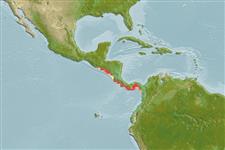
marinhas; estuarina pelagic-neritic; intervalo de profundidade 0 - 50 m (Ref. 189). Tropical; 14°N - 6°N, 91°W - 77°W (Ref. 189)
Eastern Central Pacific: El Salvador to Panama Bay and possibly northern Ecuador.
Tamanho / Peso / Idade
Maturidade: Lm ? range ? - ? cm
Max length : 20.5 cm SL macho/indeterminado; (Ref. 189)
Descrição breve
Chaves de identificação | Morfologia | Morfometria
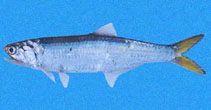
Espinhos dorsais (total) : 0; Espinhos anais: 0; Raios anais moles: 21 - 24. Snout about 2/3 eye diameter; maxilla moderate, tip somewhat bluntly rounded, reaching almost to sub-operculum, teeth becoming larger after first third of jaw. Lower gill rakers fairly short, none rudimentary. Dorsal fin origin behind midpoint of body; anal fin origin under anterior third of dorsal fin base. Silver stripe lost in larger fishes; a curve of black dots on operculum .
Body shape (shape guide): elongated; Cross section: compressed.
Occurs inshore but entering brackish if not fresh water (thus probably similar to L. grossidens). Feeds on fishes (including other anchovies), perhaps also crustaceans. Nearly ripe females occurred in the Gulf of Nicoya, Costa Rica in June, August and September, and juveniles of 3.3-4.5 cm in January and October. TL = 1.257 SL.
Ciclo de vida e comportamento de acasalamento
Maturidade | Reprodução | Desova | Ovos | Fecundidade | Larvas
Nearly ripe females occurred in the Gulf of Nicoya, Costa Rica in June, August and September, and juveniles of 3.3 to 4.5 cm in January and October.
Whitehead, P.J.P., G.J. Nelson and T. Wongratana, 1988. FAO Species Catalogue. Vol. 7. Clupeoid fishes of the world (Suborder Clupeoidei). An annotated and illustrated catalogue of the herrings, sardines, pilchards, sprats, shads, anchovies and wolf-herrings. FAO Fish. Synop. 125(7/2):305-579. Rome: FAO. (Ref. 189)
Categoria na Lista Vermelha da IUCN (Ref. 130435: Version 2025-2 (Global))
Ameaça para o homem
Harmless
Utilização humana
Pescarias: pescarias de subsistência
Ferramentas
Relatórios especiais
Descarregue XML
Fontes da internet
Estimativas baseadas em modelos
Temperatura preferida (Ref.
123201): 24.4 - 28.6, mean 27.8 °C (based on 16 cells).
Índice de diversidade filogenética (Ref.
82804): PD
50 = 0.5312 [Uniqueness, from 0.5 = low to 2.0 = high].
Bayesian length-weight: a=0.00525 (0.00247 - 0.01115), b=3.14 (2.97 - 3.31), in cm total length, based on LWR estimates for this (Sub)family-body shape (Ref.
93245).
Nível Trófico (Ref.
69278): 4.2 ±0.73 se; based on food items.
Resiliência (Ref.
120179): Elevada, tempo mínimo de duplicação da população menor que 15 meses (Preliminary K or Fecundity.).
Vulnerabilidade da pesca (Ref.
59153): Low vulnerability (15 of 100).
🛈