>
Eupercaria/misc (Various families in series Eupercaria) >
Labridae (Wrasses) > Julidinae
Etymology: Coris: Greek, kore, -es = pupil and also with themenaing of "maid" (Ref. 45335).
More on author: Linnaeus.
Lingkungan: lingkungan / zona iklim / kisaran kedalaman / jangkauan distribusi
Ekologi
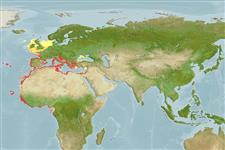
laut berasosiasi dengan karang; kisaran kedalaman 0 - 120 m (Ref. 27115), usually 1 - 60 m (Ref. 4742). Temperate; 18°C - 22°C (Ref. 27115); 59°N - 1°S, 32°W - 36°E
Eastern Atlantic: Sweden to south of Cape Lopez, Gabon. Also known from the Mediterranean Sea. Specimen of Coris from Cape Verde and Senegal southward are probably Coris atlantica (Ref. 33411), here still treated as a junior synonym pending a definite publication of validity.
Ukuran / Berat / umur
Kematangan: Lm ? range ? - ? cm
Max length : 30.0 cm SL jantan/; (Ref. 2683); common length : 20.0 cm SL jantan/; (Ref. 4742); Umur maksimum dilaporkan: 7 Tahun (Ref. 72479)
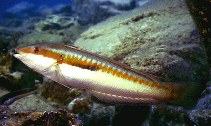
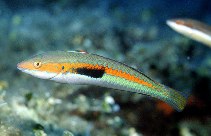
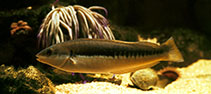
Duri punggung (Keseluruhan (total)) : 8 - 10; duri punggung lunak (Keseluruhan (total)) : 11 - 12; Duri dubur: 3; Sirip dubur lunak: 11 - 12. Snout with 4-6 cephalic pores. Spiny rays flexible. No scales on head and on base of dorsal and anal fins. Vertebrae 25-26. Males: first 3 dorsal rays elongated, with an orange or red and black spot. Along the flanks, a- longitudinal zigzag orange or red stripe. Females and juveniles: a longitudinal large whitish stripe along flanks, a mid-longitudinal zigzag, dark brown stripe.
Body shape (shape guide): fusiform / normal.
Occurs in the littoral zone, near rocks and eelgrass beds. Usually found between 1-60 m, but old males stay in deeper water. Found in deeper waters during winter. Sometimes solitary, among rocks, often with numerous specimens in its immediate vicinity. Buries itself in sand at night or when frightened. Feeds on small gastropods, sea urchins, shrimps, worms, isopods and amphipods. Sexually mature when 1 year old. Protogynous species; females change sex to become males; specimen above 18 cm length are all males (Ref. 35388). Pelagic eggs (Ref. 4742).
Females change sex to males before 18 cm TL. Sex reversal is completed in several weeks up to 5.5 months (Ref. 34185, 34255, 35388). Also Ref. 103751.
Quignard, J.-P. and A. Pras, 1986. Labridae. p. 919-942. In P.J.P. Whitehead, M.-L. Bauchot, J.-C. Hureau, J. Nielsen and E. Tortonese (eds.) Fishes of the north-eastern Atlantic and the Mediterranean. UNESCO, Paris. Vol. 2. (Ref. 4742)
Status IUCN Red List (Ref. 130435: Version 2025-2 (Global))
ancaman kepada manusia
Harmless
penggunaan manusia
Perikanan: nilai komersial kecil; Ikan buruan: ya; Akuarium: Komersial
Alat, peralatan
laporan khas
muat turun XML
Sumber internet
Estimasi berdasarkan model
Suhu yang disukai (Acuan
123201): 13.3 - 27.7, mean 19 °C (based on 636 cells).
Indeks keanekaragaman filogenetik (Acuan
82804): PD
50 = 0.5000 [Uniqueness, from 0.5 = low to 2.0 = high].
Bayesian length-weight: a=0.00851 (0.00732 - 0.00989), b=3.06 (3.02 - 3.10), in cm total length, based on LWR estimates for this species (Ref.
93245).
Tingkat Trofik (Acuan
69278): 3.4 ±0.1 se; based on diet studies.
Daya lenting (Acuan
120179): sedang, Waktu penggandaan populasi minimum 1.4 - 4.4 tahun (K=0.11; tm=1).
Kerentanan Penangkapan Ikan (Ref.
59153): Moderate vulnerability (39 of 100).
🛈
Kerentanan Iklim (Ref.
125649): Low to moderate vulnerability (28 of 100).
🛈
Nutrisi (Ref.
124155): Calcium = 12.9 [4.0, 36.3] mg/100g; Iron = 0.195 [0.108, 0.408] mg/100g; Protein = 18.6 [15.7, 20.8] %; Omega3 = 0.372 [0.156, 0.851] g/100g; Selenium = 8.22 [2.61, 25.53] μg/100g; VitaminA = 81.3 [20.5, 383.2] μg/100g; Zinc = 1 [0, 2] mg/100g (wet weight);