>
Blenniiformes (Blennies) >
Blenniidae (Combtooth blennies) > Salariinae
Etymology: Istiblennius: Greek, istios = sail + Greek, blennios = mucus (Ref. 45335).
Eponymy: Baron Dr Sir Ferdinand Jacob Heinrich von Müller (1825–1896) was a German-born Australian botanist, geographer, explorer, physician, and naturalist. [...] (Ref. 128868), visit book page.
More on author: Klunzinger.
Ambiente: milieu / zona climática / intervalo de profundidade / gama de distribuição
Ecologia
marinhas demersal; intervalo de profundidade 0 - 1 m (Ref. 90102). Tropical
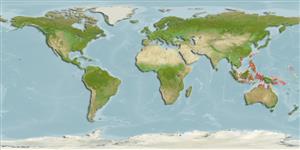
Western Pacific: Hsiao-liu-chiu Island, off southwestern Taiwan; south to Kur Island, Indonesia.
Tamanho / Peso / Idade
Maturidade: Lm ? range ? - ? cm
Max length : 7.0 cm SL macho/indeterminado; (Ref. 9962); 5.5 cm SL (female)
Descrição breve
Chaves de identificação | Morfologia | Morfometria
Espinhos dorsais (total) : 12 - 14; Raios dorsais moles (total) : 19 - 21; Espinhos anais: 2; Raios anais moles: 21 - 23. Dorsal fin XII-XIV, 19-21; membrane between spinous and segmented-ray portions notched deeper than half length of first segmented ray; membrane from posteriormost ray beginning from between dorsal edge of caudal peduncle at caudal-fin base (rarely) to dorsal edge of caudal fin up to 18% caudal-fin length in specimens ? 3 cm SL; anal fin II, 21-23 (23 only in males); pectoral-fin rays 13-14; vertebrae 10+27 to 30 = 37 to 40 (rarely 40); lacking nape cirrus; orbital cirrus simple, rarely a single branch or a few short, fine filaments at tip, typically shorter than orbital diameter; nasal cirrus simple, relatively long (typically half orbital diameter); lateral line canal continuous anterodorsally with simple pores (no vertical pairs), extending posteriorly to between verticals from bases of 6th and 9th dorsal-fin spines (usually to between verticals from 7th and 8th spines), then continuing posteriorly and posteroventrally as series of 1-6 (rarely 1 or 6) short, disconnected, horizontally bi-pored canals/tubes in skin; posteriormost tube area below and between verticals from bases of 7th spine and second segmented dorsal-fin ray (rarely posterior to vertical from 12th spine); mandibular pores 3-5; lacking posterior canines; ventral margin of upper lip and dorsal margin of lower lip entire; both sexes from ?3 cm SL with well-developed, fleshy, blade-like crest on dorsal part of head; crest of females comparatively smaller than males’; spinous portion of dorsal fin dusky, crossed by several diagonal, paler-dusky stripes with dark margins; segmented ray portion faint dusky with numerous dark pinstripes coursing length of fin, stripes coalescing into reticular pattern posteriorly. Male max. size ca 7 cm SL; female max. size ca 5.5 cm.
Body shape (shape guide): elongated.
Facultative air-breathing (Ref. 126274); Adults occur in tide pools and close to edge of rocky shores at low tide. Oviparous. Eggs are demersal and adhesive (Ref. 205), and are attached to the substrate via a filamentous, adhesive pad or pedestal (Ref. 94114). Larvae are planktonic, often found in shallow, coastal waters (Ref. 94114).
Ciclo de vida e comportamento de acasalamento
Maturidade | Reprodução | Desova | Ovos | Fecundidade | Larvas
Oviparous, distinct pairing (Ref. 205).
Springer, V.G. and J.T. Williams, 1994. The Indo-West Pacific blenniid fish genus Istiblennius reappraised: a revision of Istiblennius, Blenniella, and Paralticus, new genus. Smithson. Contrib. Zool. 565:1-193. (Ref. 9962)
Categoria na Lista Vermelha da IUCN (Ref. 130435: Version 2025-2 (Global))
Ameaça para o homem
Harmless
Utilização humana
Ferramentas
Relatórios especiais
Descarregue XML
Fontes da internet
Estimativas baseadas em modelos
Temperatura preferida (Ref.
123201): 25.4 - 29.3, mean 28.8 °C (based on 783 cells).
Índice de diversidade filogenética (Ref.
82804): PD
50 = 0.5001 [Uniqueness, from 0.5 = low to 2.0 = high].
Bayesian length-weight: a=0.00776 (0.00354 - 0.01702), b=3.00 (2.81 - 3.19), in cm total length, based on LWR estimates for this (Sub)family-body shape (Ref.
93245).
Nível Trófico (Ref.
69278): 2.0 ±0.00 se; based on food items.
Resiliência (Ref.
120179): Elevada, tempo mínimo de duplicação da população menor que 15 meses (Preliminary K or Fecundity.).
Vulnerabilidade da pesca (Ref.
59153): Low vulnerability (10 of 100).
🛈