>
Petromyzontiformes (Lampreys) >
Petromyzontidae (Northern lampreys) > Petromyzontinae
Etymology: Ichthyomyzon: ichthys, fish; myzon (Gr.), to suck (borrowed from Petromyzon), i.e., a sucking fish, referring to their suctorial behavior (See ETYFish); castaneus: Latin for chestnut-brown, referring to its “uniform chesnut [sic] tint” (See ETYFish).
More on author: Girard.
Taxonomic Remarks
Hubbs and Trautman (1937) suggested that one adult specimen from Green Bay, near Gladstone, Lake Michigan Basin, might be a hybrid between I. castaneus and I. unicuspis and Starrett et al. (1960) suggested that an adult specimen from the Mississippi River, at Moline, Illinois might be a hybrid between I. castaneus and I. unicuspis (Ref. 89241).
Môi trường: môi trường / vùng khí hậu / Mức độ sâu / phạm vi phân phối
Sinh thái học
; nước ngọt gần đáy; di cư trong nước ngọt (Ref. 126106). Subtropical; 50°N - 29°N
North America: Hudson Bay, Laurentian Great Lakes and Gulf of Mexico basins.
Chiều dài lúc trưởng thành đầu tiên / Bộ gần gũi / Khối lượng (Trọng lượng) / Tuổi
Chín muồi sinh dục: Lm 10.1 range ? - ? cm
Max length : 38.0 cm TL con đực/không giới tính; (Ref. 5723); common length : 20.5 cm TL con đực/không giới tính; (Ref. 12193); Tuổi cực đại được báo cáo: 8 các năm (Ref. 12193)
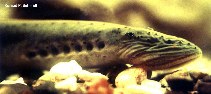
Dorsal fin slightly notched; oral disc narrower than head; teeth blunt and poorly; usually 52-56 trunk myomeres; black on lateral-line pores (Ref. 86798). Other diagnostic features: 8.5-36.3 cm TL. Body proportions, as percentage of TL (based on 36 specimens measuring 8.9-26.1 cm TL): prebranchial length, 11.5-15.5; branchial length, 7.3-12.6; trunk length, 44.4-52.9; tail length, 23.9-34.4; eye length, 0.8-2.4; disc length, 5.4 -11.6. The urogenital papilla length, as a percentage of branchial length, in a spawning male 18.3 cm TL, 5.3. Trunk myomeres, 49-58. Dentition: supraoral lamina, 1-5 teeth, usually 2-3; infraoral lamina, 6-13 teeth; typically 4 endolateral teeth on each side, but 5 teeth also occur; 1-8, mode of 6, bicuspid endolaterals in total, the other endolaterals, if any, unicuspid; 2-5 rows of anterials, usually 4; first row of anterials, 3 teeth; 4-10 rows of exolaterals on each side, usually 6-7; 2-3 rows of posterials; first row of posterials, 8-11 usually unicuspid teeth, but one lateralmost may be bicuspid; crest of transverse lingual lamina variable, linear or weakly w-shaped to rarely strongly w-shaped, with numerous cusps, the median one not enlarged; longitudinal lingual laminae number of teeth unrecorded. Additonally, one accessory tooth is occasionally developed inside the ring formed by the supraoral and infraoral laminae and the endolateral teeth. Velar tentacles, 2, smooth. Body coloration (preserved) in adults grading from darker on the upper surface to paler on the lower surface; lateral aspects sometimes mottled; spent adults blue-black. Lateral line neuromasts darkly pigmented beginning around 15 cm TL. Caudal fin pigmentation, 75% or more. Caudal fin shape, rounded. Oral fimbriae, 90-126. Oral papillae, 15-30 (Ref. 89241).
Body shape (shape guide): eel-like.
Freshwater (Ref. 89241). Adults iInhabit lakes and streams. Ammocoete larvae occur in pools and backwaters (Ref.1998). Ammocoetes more commonly found in firm, relatively stable, sand-silt substrate, in areas with current. Adults occur in still to swift water, clear to brown-tinged, over rocky and weedy substrates, to a maximum depth of 20 m. The usual habitat is large to medium-sized rivers with summer flows 0.8-31 m3/s and summer water temperatures 15.5-22 ˚C. It can also occur in small to large lakes. Generally associated with warm water habitats and tolerant of variation in terms of discharge, water temperature, and substrate. Spawning adults only found in streams. Metamorphosis occurs in October, in Michigan. Adults parasitic on fishes (introduced Cyprinus carpio and native Catostomus commersonii, Ictiobus sp., Moxostoma sp., Esox lucius, Salvelinus fontinalis). Reported scavenging on Catostomus sp. In Manitoba, spawning behavior has been observed on 11-12 June at a water temperature of 16.5 °C and current velocity about 1 m/s. In Michigan, the spawning period is from 28 May to 25 June, at water temperatures between 15.6-22.2 ˚C, with peak spawning activity in early June. Nests (up to 6.2 m X 1 m X 0.05 m) are built with stones 3.5-5 cm in diameter in streams having 6.5-43 m width, 38-90 cm depth, and 1.1-54 m3/s flow. Up to four spawning lampreys have been found in a nest in Michigan and about 50 in Manitoba. Eggs are elliptical with long axis 0.64 mm and short axis 0.56 mm on average. Eggs are preyed upon by Luxilus cornutus. There are reported occurrences in Michigan of communal spawning of Chestnut Lamprey with Sea Lamprey (Pine, Platte, and Muskegon rivers) and of Chestnut Lamprey with Sea Lamprey and American Brook Lamprey (Betsie River) (Ref. 89241). Adults ascend streams to spawn and die soon after egg laying is completed. Semelparous (Ref. 1998). In the Laurentian Great Lakes Basin, it has presumably been negatively affected by control measures directed towards Petromyzon marinus, except for the chemosterilization of males which affects only the latter species (Ref. 89241).
Semelparous (Ref. 1998). The female attaches with her oral disc to a rock at the upstream end of the nest. The male attaches to the back of her head using his oral disc and wraps his tail around her trunk region
in such a way as to have each others urogenital papilla in close proximity and through muscular contraction of his body assists in the extrusion of the eggs. They vibrate vigorously for a few seconds. This results in the release of their gametes and disturbance of the substrate, which partially buries the fertilized eggs (Ref. 89241).
Page, L.M. and B.M. Burr, 1991. A field guide to freshwater fishes of North America north of Mexico. Houghton Mifflin Company, Boston. 432 p. (Ref. 5723)
Tình trạng Sách đỏ IUCN (Ref. 130435: Version 2025-2 (Global))
Mối đe dọa đối với con người
Harmless
Sử dụng của con người
Các công cụ
Báo cáo đặc biệt
Tải xuống XML
Các nguồn internet
Ước tính dựa trên mô hình
Chỉ số đa dạng phát sinh loài (Tài liệu tham khảo
82804): PD
50 = 0.5156 [Uniqueness, from 0.5 = low to 2.0 = high].
Bayesian length-weight: a=0.00105 (0.00040 - 0.00275), b=3.03 (2.80 - 3.26), in cm total length, based on LWR estimates for this (Sub)family-body shape (Ref.
93245).
Mức dinh dưỡng (Tài liệu tham khảo
69278): 4.5 ±0.80 se; based on food items.
Thích nghi nhanh (Tài liệu tham khảo
120179): thấp, thời gian nhân đôi của chủng quần tối thiểu là 4.5 - 14 năm (tm=6; Fec = 42,000; tmax=8).
Sự dễ bị tổn thương của nghề đánh cá (Ref.
59153): Low to moderate vulnerability (28 of 100).
🛈