>
Blenniiformes (Blennies) >
Blenniidae (Combtooth blennies) > Salariinae
Etymology: Hypleurochilus: Greek, hypo = under + Greek, pleura = in the side of + Greek, cheilos = lip.
Eponymy: Herbert Otto Henry Lang (1879–1957) was born in Germany and trained as a taxidermist. [...] (Ref. 128868), visit book page.
More on author: Fowler.
Ambiente: milieu / zona climática / intervalo de profundidade / gama de distribuição
Ecologia
marinhas; estuarina demersal. Tropical
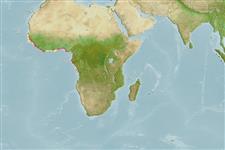
Eastern Atlantic: northern Senegal to the mouth of the Congo (Ref. 4342, 81288). Also reported from Annobon Island (Ref. 5298).
Tamanho / Peso / Idade
Maturidade: Lm ? range ? - ? cm
Max length : 8.3 cm TL macho/indeterminado; (Ref. 81288)
Descrição breve
Chaves de identificação | Morfologia | Morfometria
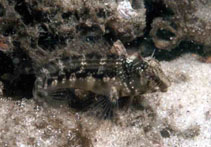
Espinhos dorsais (total) : 12; Raios dorsais moles (total) : 14 - 17; Espinhos anais: 2; Raios anais moles: 16 - 19. Diagnosis: length of supraorbital tentacles varies from approximately 2/3 of eye diameter to 2 times this diameter; longest tentacles occur in male specimens; shape of supraorbital tentacles varies from a single finger-like appendage bearing 2-4 filaments at the rear base to 4 appendages of almost equal length; anterior nostril forms a small tube which bears up to 4 cirri on posterior rim, only 1 in most cases; only one ring of cephalic sensory pores in infraorbital and preopercular series; lateral line does not reach beyond level of 8th-10th spine of dorsal fin; both males and females with a thin crest on head, but crest in females not as high as in males; dorsal fin with 12 spines and 14-17, generally 15-16, soft rays, last spine shorter than soft rays; anal fin with 2 spines and 16-19, generally 17-18, soft rays; caudal fin rounded (Ref. 81288).
Coloration: in alcohol, uniformly clear brown, lower part of head and throat clearer; some individuals with a black spot on membrane between 1st and 3rd dorsal spines; sometimes flanks bearing vertical stripes darker (Ref. 81288).
Body shape (shape guide): elongated.
Euryhaline, entering mouth of large rivers and mangroves, but always in brackish water (Ref. 81288). Oviparous. Eggs are demersal and adhesive (Ref. 205), and are attached to the substrate via a filamentous, adhesive pad or pedestal (Ref. 94114). Larvae are planktonic, often found in shallow, coastal waters (Ref. 94114). Maximum SL recorded was 7.0 cm (Ref. 4342).
Ciclo de vida e comportamento de acasalamento
Maturidade | Reprodução | Desova | Ovos | Fecundidade | Larvas
Oviparous, distinct pairing (Ref. 205).
Bath, H., 1986. Blenniidae. p. 355-357. In J. Daget, J.-P. Gosse and D.F.E. Thys van den Audenaerde (eds.) Check-list of the freshwater fishes of Africa (CLOFFA). ISNB, Brussels, MRAC, Tervuren; and ORSTOM, Paris. Vol. 2. (Ref. 4342)
Categoria na Lista Vermelha da IUCN (Ref. 130435: Version 2025-2 (Global))
Ameaça para o homem
Harmless
Utilização humana
Pescarias: sem interesse
Ferramentas
Relatórios especiais
Descarregue XML
Fontes da internet
Estimativas baseadas em modelos
Temperatura preferida (Ref.
123201): 25.2 - 28, mean 27.3 °C (based on 164 cells).
Índice de diversidade filogenética (Ref.
82804): PD
50 = 0.5005 [Uniqueness, from 0.5 = low to 2.0 = high].
Bayesian length-weight: a=0.00776 (0.00354 - 0.01702), b=3.00 (2.81 - 3.19), in cm total length, based on LWR estimates for this (Sub)family-body shape (Ref.
93245).
Nível Trófico (Ref.
69278): 3.2 ±0.3 se; based on size and trophs of closest relatives
Resiliência (Ref.
120179): Elevada, tempo mínimo de duplicação da população menor que 15 meses (Preliminary K or Fecundity.).
Vulnerabilidade da pesca (Ref.
59153): Low vulnerability (10 of 100).
🛈