>
Eupercaria/misc (Various families in series Eupercaria) >
Malacanthidae (Tilefishes)
Etymology: Hoplolatilus: Greek, hoplon = weapon + Latin, latus = wide (Ref. 45335); randalli: Named for John E. Randall, in recognition of his numerous valuable contributions to our knowledge of Indo-Pacific fishes and particularly his previous work on the genus Hoplolatilus.
Eponymy: Dr John ‘Jack’ Ernest Randall Jr. [...] (Ref. 128868), visit book page.
Ambiente: milieu / zona climatica / distribuzione batimetrica / gamma di distribuzione
Ecologia
marino associati a barriera corallina; distribuzione batimetrica 30 - 85 m (Ref. 85568). Tropical
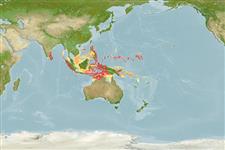
Indo West Pacific: Indonesia, Philipines, Palau, Yap Is. and the Solomon Islands.
Dimensione / Peso / Età
Maturità: Lm ? range ? - ? cm
Max length : 15.4 cm SL maschio/sesso non determinato; (Ref. 85568)
Breve descrizione
Chiavi di identificazione | Morfologia | Morfometria
Spine dorsali (totale) : 10; Raggi dorsali molli (totale) : 13; Spine anali: 2; Raggi anali molli: 12; Vertebre: 24. This species is distinguished by the following characters: D X,13; A II,12; pectoral rays 17; total gill rakers on first branchial arch 27-29; pored lateral line scales 84-92 with 98-120 scales in lateral series above lateral line; preopercular serrae 16-23; greatest body depth 3.4-3.9 in SL; length of last dorsal spine 2.5-3.0 in HL; longest soft dorsal ray 1.1-1.4 in HL; colour in life mainly greenish (darker dorsally), shading to light blue on lower head, thorax, and abdomen; caudal peduncle with an elongate sky aqua-blue saddle-like spot dorsally; narrow sky-blue band from front of snout to lower edge of eye; lips mainly blue; narrow yellow-orange band just below blue band, passing just under eye to posterior margin of preoperculum; dorsal and anal fins pale yellow with pink margin; caudal fin reddish with indistinct central pale streak, the upper and lower margins narrowly light blue to pinkish; pectoral fins mainly translucent except upper 4-5 rays blue; pelvic fins bluish white; iris yellow with bright blue streak dorsally and ventrally (Ref. 85568).
Body shape (shape guide): fusiform / normal; Cross section: compressed.
Inhabits gentle rubble slopes; constructs impressive rubble mounds over its burrows, which range from about 50-70 cm in height and 1.5-2 m in diameter and typically, the fish are seen hovering a short distance from their home mound, with up to six individuals using a single mound. The fish when approached closely or frightened by spear shots, quickly retreat
into the burrow, which is located near the apex of the mound (Ref. 85568).
Ciclo vitale e comportamento di accoppiamento
Maturità | Riproduzione | Deposizione | Uova | Fecondità | Larve
Allen, G.R., M.V. Erdmann and A.M. Hamilton, 2010. Hoplolatilus randalli, a new species of sand tilefish (Pisces: Malacanthidae) from the tropical western Pacific with comments on the validity of H. luteus. aqua, Int. J. Ichthyol. 16(4):171-186. (Ref. 85568)
Stato della Lista Rossa IUCN (Ref. 130435: Version 2025-2 (Global))
Minaccia per l'uomo
Harmless
Usi umani
Pesca: di potenziale interesse
Strumenti
Rapporti speciali
Scarica XML
Fonti Internet
Stime basate su modelli
Temperatura preferita (Fonte Biblio.
123201): 26.7 - 28.6, mean 27.6 °C (based on 41 cells).
Indice di diversità filogenetica (Fonte Biblio.
82804): PD
50 = 0.5001 [Uniqueness, from 0.5 = low to 2.0 = high].
Bayesian length-weight: a=0.01122 (0.00514 - 0.02450), b=3.04 (2.87 - 3.21), in cm total length, based on all LWR estimates for this body shape (Ref.
93245).
Livello trofico (Fonte Biblio.
69278): 3.5 ±0.5 se; based on size and trophs of closest relatives
Vulnerabilità della pesca (Ref.
59153): Low vulnerability (10 of 100).
🛈