Classificação / Nomes
Nomes comuns | Sinónimos | Catalog of Fishes(Género, Espécies) | ITIS | CoL | WoRMS | Cloffa
>
Siluriformes (Catfishes) >
Doradidae (Thorny catfishes) > Doradinae
Etymology: Hassar: Origin of the name was not specified by the author, but it is possible that it refers to the name commonly applied to certain catfishes in Guyana, such as Hoplosternum littorale or Hypostomus watawata; gabiru: Named for Leandro Melo de Sousa, known to his friends as "Gabiru", for his many contributions to the understanding of the Doradidae, including his MSc and PhD dissertations (Sousa & Rapp Py-Daniel, 2005; Sousa, 2010). Leandro also helped to collect part of the type series of the new species. Treated as a noun in apposition.
Eponymy: Dr Leandro Melo de Sousa is known to his friends as ‘Gabiru’. [...] (Ref. 128868), visit book page.
Ambiente: milieu / zona climática / intervalo de profundidade / gama de distribuição
Ecologia
; Água doce bentopelágico. Tropical; 4°S - 14°S, 52°W - 55°W
South America: Brazil. Occurs in the middle to upper Xingu river basin, and is apparently endemic to the Xingu basin above the raids of Volta Grande, near Altamira.
Tamanho / Peso / Idade
Maturidade: Lm ? range ? - ? cm
Max length : 28.5 cm TL macho/indeterminado; (Ref. 111518); peso máx. Publicado: 292.00 g (Ref. 111518)
Descrição breve
Chaves de identificação | Morfologia | Morfometria
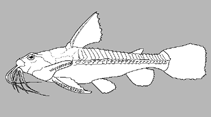
Hassar gabiru is distinguished from H. orestis and H. wilderi by having two weakly-branched diverticula restricted to each side of anterior chamber of gas bladder (rarely one extra pair on posterior chambers) (vs. gas bladder with many well-branched diverticula along margins of entire bladder); and gas bladder rounded posteriorly (vs. gas bladder triangular posteriorly, each posterior chamber extended posteriorly into a short terminal diverticulum sharing medial septum with its pair). Hassar gabiru is further distinguished from H. orestis by having 11th through 15th, modally 13th, midlateral scute as the anteriormost with median thorn (vs. 1st through 8th, modally 3rd), tip of upper caudal-fin lobe not darkened (vs. usually darkened), body depth at dorsal-fin origin 24.3-33.1%, mean 25.8% SL (vs. 16.8-22.2%, mean 21.1% L), body depth at anal-fin origin 15.9-20.7%, mean 17.3% SL (vs. 10.0-14.7%, mean 13.1% SL), and caudal peduncle depth 6.6-8.6%, mean 7.1% SL (vs. 4.3-6.4%, mean 5.5% SL). Hassar gabiru is distinguished from H. affinis by having the distal tip of the first branched dorsal-fin rays and membranes pale (vs. first branched dorsal-fin rays and membranes distally darkened); and lateral diverticula on the gas bladder fingerlike, weakly-branched in large specimens (vs. rounded, rarely branched in large specimens) (Ref. 87857).
Body shape (shape guide): fusiform / normal.
Like its congeners, this species was usually collected in swift water over sand beaches at night. It has been considered that specimens of Hassar orestis(=Hassar gabiru) collected at the Volta Grande rapids have preference for benthic invertebrates and detritus (Ref. 87857).
Ciclo de vida e comportamento de acasalamento
Maturidade | Reprodução | Desova | Ovos | Fecundidade | Larvas
Birindelli, J.O., D.F. Fayal and W.B. Wosiacki, 2011. Taxonomic revision of thorny catfish genus Hassar (Siluriformes: Doradidae). Neotrop. Ichthyol. 9(3):515-542. (Ref. 87857)
Categoria na Lista Vermelha da IUCN (Ref. 130435: Version 2025-2 (Global))
Ameaça para o homem
Harmless
Utilização humana
Ferramentas
Relatórios especiais
Descarregue XML
Fontes da internet
Estimativas baseadas em modelos
Índice de diversidade filogenética (Ref.
82804): PD
50 = 0.5312 [Uniqueness, from 0.5 = low to 2.0 = high].
Bayesian length-weight: a=0.01288 (0.00700 - 0.02369), b=3.00 (2.83 - 3.17), in cm total length, based on LWR estimates for this species & (Sub)family-body (Ref.
93245).
Nível Trófico (Ref.
69278): 2.8 ±0.4 se; based on size and trophs of closest relatives
Resiliência (Ref.
120179): Elevada, tempo mínimo de duplicação da população menor que 15 meses (Preliminary K or Fecundity.).
Vulnerabilidade da pesca (Ref.
59153): Low vulnerability (19 of 100).
🛈