>
Eupercaria/misc (Various families in series Eupercaria) >
Haemulidae (Grunts) > Haemulinae
Etymology: Haemulon: Greek, haimaleos = bloody (Ref. 45335).
Eponymy: Charles Plumier (1646–1704) was a Franciscan monk, botanist and naturalist. [...] (Ref. 128868), visit book page.
More on author: Lacepède.
Ambiente: milieu / zona climática / intervalo de profundidade / gama de distribuição
Ecologia
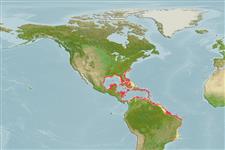
marinhas associadas(os) a recifes; intervalo de profundidade 3 - 40 m (Ref. 9626). Subtropical; 39°N - 23°S, 99°W - 30°W
Western Atlantic: Chesapeake Bay, through the Gulf of Mexico and Caribbean southward to Brazil. Including Antilles (Ref. 26938).
Comprimento na primeira maturidade / Tamanho / Peso / Idade
Maturidade: Lm 18.3, range 11 - 23.23 cm
Max length : 53.0 cm TL macho/indeterminado; (Ref. 40637); common length : 30.0 cm TL macho/indeterminado; (Ref. 3798); peso máx. Publicado: 4.4 kg (Ref. 83530); Idade máx. registada: 13 anos (Ref. 3205)
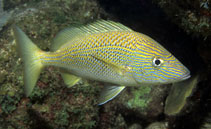
Espinhos dorsais (total) : 12; Raios dorsais moles (total) : 17; Espinhos anais: 3; Raios anais moles: 9. Side of head has narrow blue stripes; scales above lateral line much larger than those below (Ref. 26938). Scale rows just below lateral line oblique; color variable but usually light yellowish (Ref. 13442).
Body shape (shape guide): fusiform / normal.
Found in dense aggregations during the day on patch reefs, around coral formations, or on sandy bottoms (Ref. 9710). Juveniles common in Thalassia testudinum beds (Ref. 5217). Feeds on crustaceans, small mollusks, and small fishes. Frequently exhibits a territorial 'kissing' display in which two contenders push each other on the lips with their mouths wide open (Ref. 9710). Marketed fresh. Has been reared in captivity (Ref. 35420).
Oviparous, distinct pairing during breeding (Ref. 205).
Courtenay, W.R. and H.F. Sahlman, 1978. Pomadasyidae. In W. Fischer (ed.) FAO species identification sheets for fishery purposes. Western Central Atlantic (Fishing Area 31), Volume 4. FAO, Rome. (Ref. 3798)
Categoria na Lista Vermelha da IUCN (Ref. 130435: Version 2025-2 (Global))
Ameaça para o homem
Reports of ciguatera poisoning (Ref. 30303)
Utilização humana
Pescarias: pouco comercial; peixe desportivo: sim; Aquário: Aquários públicos
Ferramentas
Relatórios especiais
Descarregue XML
Fontes da internet
Estimativas baseadas em modelos
Temperatura preferida (Ref.
123201): 23.4 - 28, mean 25.9 °C (based on 342 cells).
Índice de diversidade filogenética (Ref.
82804): PD
50 = 0.5000 [Uniqueness, from 0.5 = low to 2.0 = high].
Bayesian length-weight: a=0.01445 (0.01202 - 0.01738), b=2.97 (2.93 - 3.01), in cm total length, based on LWR estimates for this species (Ref.
93245).
Nível Trófico (Ref.
69278): 3.8 ±0.0 se; based on diet studies.
Generation time: 3.5 (3.1 - 7.0) years. Estimated as median ln(3)/K based on 11
growth studies.
Resiliência (Ref.
120179): Baixo, tempo mínimo de duplicação da população 4,5 - 14 anos (K=0.11-0.4; tm=2; tmax=13; Fec=64,000).
Vulnerabilidade da pesca (Ref.
59153): High vulnerability (62 of 100).
🛈
Nutrientes (Ref.
124155): Calcium = 18.3 [6.7, 44.4] mg/100g; Iron = 0.473 [0.231, 0.908] mg/100g; Protein = 20 [18, 22] %; Omega3 = 0.187 [0.092, 0.339] g/100g; Selenium = 14.4 [6.7, 29.7] μg/100g; VitaminA = 57.2 [19.6, 171.8] μg/100g; Zinc = 0.754 [0.474, 1.170] mg/100g (wet weight);