>
Cyprinodontiformes (Rivulines, killifishes and live bearers) >
Fundulidae (Topminnows and killifishes)
Etymology: Fundulus: Latin, fundus = bottom; a peculiar name for a topminnow, coined for a bottom species of Atlantic coast being "the abode of the fundulus mudfish" (Ref. 45335).
More on author: Linnaeus.
Ambiente: milieu / zona climática / intervalo de profundidade / gama de distribuição
Ecologia
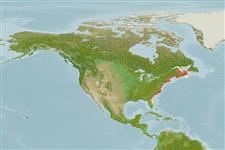
marinhas; Água doce; estuarina bentopelágico; não migratória (Ref. 126106). Temperate; 10°C - 24°C (Ref. 12468); 52°N - 28°N, 82°W - 55°W
Western Atlantic: Gulf of St. Lawrence to northeast Florida, USA. Two subspecies were previously recognized: Fundulus heteroclitus heteroclitus and Fundulus heteroclitus macrolepidotus (Ref. 86798). Introduced to southern Portugal and southern Spain (Ref. 59043).
Comprimento na primeira maturidade / Tamanho / Peso / Idade
Maturidade: Lm ?, range 4 - ? cm
Max length : 15.0 cm TL macho/indeterminado; (Ref. 27139); common length : 8.9 cm TL macho/indeterminado; (Ref. 12193); Idade máx. registada: 4 anos (Ref. 59043)
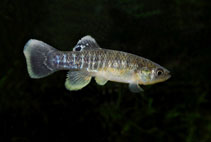
Distinguished from nearly identical species Fundulus grandis by having the following characters: more convex upper profile; dark bars alternating with silvery interspaces on side; small ocellus at rear of dorsal fin of male; and each mandible with 4 pores (Ref. 86798).
Body shape (shape guide): fusiform / normal.
Facultative air-breathing (Ref. 126274); Adults occur in saltwater marshes, tidal creeks and nearby fresh water (Ref. 86798). A resident intertidal species with homing behavior (Ref. 32612). They may leave tide pools if aquatic conditions become inhospitable (Ref. 31184). They also enter fresh water to a limited extent (Ref. 7251). Not a seasonal killifish. They breathe air when out of water (Ref. 31184). Difficult to maintain in aquariums (Ref. 27139). Introduction has caused the decline of native species and near extinction of Aphanius baeticus in southwestern Spain (Ref. 59043).
Deposits eggs in the shells of Modiolus demissus (Ref. 26281).
Page, L.M. and B.M. Burr, 2011. A field guide to freshwater fishes of North America north of Mexico. Boston : Houghton Mifflin Harcourt, 663p. (Ref. 86798)
Categoria na Lista Vermelha da IUCN (Ref. 130435: Version 2025-2 (Global))
Ameaça para o homem
Harmless
Utilização humana
Pescarias: espécies comerciais; Aquário: Espécies comerciais
Ferramentas
Relatórios especiais
Descarregue XML
Fontes da internet
Estimativas baseadas em modelos
Temperatura preferida (Ref.
123201): 6.1 - 23.7, mean 9.3 °C (based on 163 cells).
Índice de diversidade filogenética (Ref.
82804): PD
50 = 0.5000 [Uniqueness, from 0.5 = low to 2.0 = high].
Bayesian length-weight: a=0.00933 (0.00723 - 0.01205), b=3.17 (3.10 - 3.24), in cm total length, based on LWR estimates for this species (Ref.
93245).
Nível Trófico (Ref.
69278): 3.6 ±0.48 se; based on food items.
Generation time: 1.5 ( na - na) years. Estimated as median ln(3)/K based on 1
growth studies.
Resiliência (Ref.
120179): Médio, tempo mínimo de duplicação da população 1,4 - 4,4 anos (tm<1; tmax=4).
Vulnerabilidade da pesca (Ref.
59153): Low vulnerability (19 of 100).
🛈
Nutrientes (Ref.
124155): Calcium = 82.9 [39.2, 188.9] mg/100g; Iron = 0.442 [0.225, 0.881] mg/100g; Protein = 17.9 [16.5, 19.2] %; Omega3 = 0.594 [0.249, 1.464] g/100g; Selenium = 4.78 [1.73, 11.60] μg/100g; VitaminA = 29.2 [7.9, 115.4] μg/100g; Zinc = 1.09 [0.70, 1.68] mg/100g (wet weight);