>
Acanthuriformes (Surgeonfishes) >
Chaetodontidae (Butterflyfishes)
Etymology: Forcipiger: Latin, forceps = instrument of the pincers kind used for seizing and holding objects, esp. In surgical and obstetric operations + latin, gero = to carry; 1634 (Ref. 45335).
Taxonomic Remarks
The species Forcipiger cyrano Randall, 1961 is considered as valid in Eschmeyer (CofF ver. Mar. 2011: Ref. 86697) following Randall (2007: Ref. 86689).
Entorno: milieu / zona climática / rango de profundidad / gama de distribución
Ecología
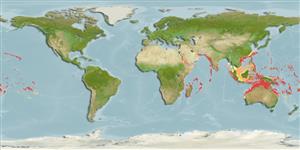
marino asociado a arrecife; no migratorio (Ref. 52884); rango de profundidad 0 - 200 m (Ref. 89972). Tropical; 28°N - 28°S, 32°E - 130°W
Indo-Pacific: East Africa to the Hawaiian, Marquesan, and Pitcairn islands, north to the Bonin [=Ogasawara] Islands, south to New Caledonia and the Austral Islands; throughout Micronesia.
Tamaño / Peso / Edad
Madurez: Lm ? range ? - ? cm
Max length : 22.0 cm TL macho / no sexado; (Ref. 9710)
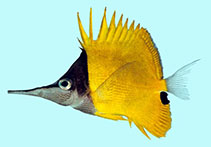
Espinas dorsales (total) : 10 - 11; Radios blandos dorsales (total) : 24 - 28; Espinas anales: 3; Radios blandos anales: 17 - 20.
Body shape (shape guide): short and / or deep; Cross section: compressed.
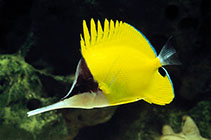
A generally uncommon species that inhabits seaward reefs to depths greater than 60 m (Ref. 9710). Benthopelagic (Ref. 58302). Adults feed mainly on whole organisms such as small crustaceans. Usually seen in pairs. Oviparous (Ref. 205), monogamous (Ref. 52884). They form pairs during breeding (Ref. 205). Sometimes dark brown instead of yellow (Ref. 48636). In the East Indian region this species is replaced by F. wanai at Cenderawasih Bay (Ref. 90102). Minimum depth reported taken from Ref. 128797.
Ciclo vital y comportamiento de apareamiento
Madurez | Reproducción | Puesta | Huevos | Fecundidad | Larva
Distinct pairing (Ref. 205). Monogamous mating is observed as both obligate and social (Ref. 52884).
Myers, R.F., 1991. Micronesian reef fishes. Second Ed. Coral Graphics, Barrigada, Guam. 298 p. (Ref. 1602)
Situación en la Lista Roja de la UICN (Ref. 130435: Version 2025-2 (Global))
Amenaza para el ser humano
Harmless
Usos humanos
Pesquerías: escaso valor comercial; Acuario: Comercial
Herramientas
Informes especiales
Descargar XML
Fuentes de Internet
Estimaciones basadas en modelos
Temperatura preferida (Referencia
123201): 24.7 - 29, mean 27.9 °C (based on 992 cells).
Índice de diversidad filogenética (Referencia
82804): PD
50 = 0.6250 [Uniqueness, from 0.5 = low to 2.0 = high].
Bayesian length-weight: a=0.02291 (0.01223 - 0.04290), b=3.02 (2.86 - 3.18), in cm total length, based on LWR estimates for this species & (Sub)family-body (Ref.
93245).
Nivel trófico (Referencia
69278): 3.5 ±0.50 se; based on food items.
Resiliencia (Referencia
120179): Alto, población duplicada en un tiempo mínimo inferior a 15 meses (Preliminary K or Fecundity.).
Vulnerabilidad pesquera (Ref.
59153): Low vulnerability (12 of 100).
🛈
Nutrientes (Ref.
124155): Calcium = 73 [37, 118] mg/100g; Iron = 0.713 [0.418, 1.163] mg/100g; Protein = 18.7 [17.5, 19.8] %; Omega3 = 0.141 [0.084, 0.234] g/100g; Selenium = 45.9 [25.1, 84.4] μg/100g; VitaminA = 47.7 [13.6, 165.1] μg/100g; Zinc = 1.14 [0.78, 1.63] mg/100g (wet weight);