Ambiente: milieu / zona climática / intervalo de profundidade / gama de distribuição
Ecologia
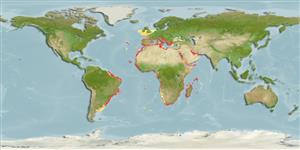
marinhas associadas(os) a recifes; intervalo de profundidade 8 - 300 m (Ref. 27000), usually ? - 50 m (Ref. 5222). Subtropical; 54°N - 43°S, 65°W - 58°E (Ref. 5222)
East and Southwest Atlantic and Western Indian Ocean: East Atlantic: throughout the Mediterranean Sea, and from the southern Bay of Biscay to southern tip of Africa. Stray specimens reported from the British Isles, and eastern English Channel (Normandy, France; Ref. 92236). Southwest Atlantic: southeastern Brazil, Uruguay, and Argentina. Western Indian Ocean: from tip of Africa to southern Mozambique and southern Madagascar. Reported from Oman and La Reunion I.
Comprimento na primeira maturidade / Tamanho / Peso / Idade
Maturidade: Lm 49.2, range 37 - 54 cm
Max length : 150 cm TL macho/indeterminado; (Ref. 12382); peso máx. Publicado: 60.0 kg (Ref. 5222); Idade máx. registada: 60 anos (Ref. 94520)
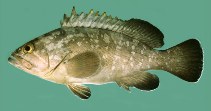
Espinhos dorsais (total) : 11; Raios dorsais moles (total) : 14 - 16; Espinhos anais: 3; Raios anais moles: 8 - 9. Diagnosis: head and body dark reddish brown or greyish dorsally, usually yellowish gold ventrally; irregular white, pale greenish yellow or silvery grey blotches usually visible on the body and head and mostly arranged in vertical series; more or less distinct black maxillary streak; dark brown median fins; distal edge of anal and caudal fins, often also pectoral fins, narrowly white; pelvic fins blackish distally; pectoral fins dark reddish brown or grey; margin of spinous dorsal fin and basal part of the paired fins often golden yellow; head length 2.3-2.5 in SL; convex interorbital area; rounded preopercle, finely serrate, serrae at angle slightly enlarged; smooth subopercle and interopercle; eye diameter greater than or subequal to interorbital width in fish 10-30 cm SL, less than interorbital in fish over 40 cm SL; posterior and anterior nostrils subequal or posterior nostril slightly larger; maxilla naked, reaching to or slightly past vertical at rear edge of eye; 2-4 rows of subequal teeth on midlateral part of lower jaw (Ref. 89707).
Body shape (shape guide): fusiform / normal; Cross section: compressed.
Adults prefer rocky bottoms (Ref. 5222), are solitary and territorial (Ref. 12382). Juveniles are found closer to shore (Ref. 48605) in rocky tidal pools (Ref. 48609). Enters brackish environments (Ref. 57293). Mainly feed on crabs and octopi; larger individuals feed on a greater proportion of fishes, the majority of which are reef-associated species (Ref. 6842). A protogynous hermaphrodite (Ref. 55367). Mature individuals form spawning aggregations (Ref. 55367). Utilized as a food fish (Ref. 171). Readily caught by anglers (Ref. 5222). Not adapted well in an aquarium (Ref. 12382).
A monandric species (Ref. 55367). In Europe, sex reversal occurs when females are about 14-17 years of age and between 80 to 90 cm TL (Ref. 51466). From another study, sex change occurs at 88 cm TL and 12 years of age (Ref. 55367), between 52-77 cm TL and 7-17 years (Ref. 94520).
Protogynous hermaphrodite species, reaching its first sexual maturity as female at 5 years and becoming male after 10 years (some females remain so for some more years). Spawning happens during summer.
Heemstra, P.C. and J.E. Randall, 1993. FAO Species Catalogue. Vol. 16. Groupers of the world (family Serranidae, subfamily Epinephelinae). An annotated and illustrated catalogue of the grouper, rockcod, hind, coral grouper and lyretail species known to date. Rome: FAO. FAO Fish. Synop. 125(16):382 p. (Ref. 5222)
Categoria na Lista Vermelha da IUCN (Ref. 130435: Version 2025-2 (Global))
Ameaça para o homem
Harmless
Utilização humana
Pescarias: altamente comercial; peixe desportivo: sim
Ferramentas
Relatórios especiais
Descarregue XML
Fontes da internet
Estimativas baseadas em modelos
Temperatura preferida (Ref.
123201): 13.3 - 25.8, mean 19 °C (based on 33 cells).
Índice de diversidade filogenética (Ref.
82804): PD
50 = 0.5000 [Uniqueness, from 0.5 = low to 2.0 = high].
Bayesian length-weight: a=0.01023 (0.00664 - 0.01576), b=3.07 (2.95 - 3.19), in cm total length, based on LWR estimates for this species & Genus-body shape (Ref.
93245).
Nível Trófico (Ref.
69278): 4.4 ±0.0 se; based on diet studies.
Resiliência (Ref.
120179): Baixo, tempo mínimo de duplicação da população 4,5 - 14 anos (K=0.03-0.09; tmax=50; tm=7).
Prior r = 0.36, 95% CL = 0.24 - 0.55, Based on 5 data-limited stock assessments.
Vulnerabilidade da pesca (Ref.
59153): High vulnerability (64 of 100).
🛈
Vulnerabilidade climática (Ref.
125649): Moderate vulnerability (38 of 100).
🛈
Nutrientes (Ref.
124155): Calcium = 8.45 [3.09, 17.95] mg/100g; Iron = 0.361 [0.182, 0.786] mg/100g; Protein = 19.5 [17.9, 21.0] %; Omega3 = 0.187 [0.101, 0.362] g/100g; Selenium = 29.3 [13.7, 60.8] μg/100g; VitaminA = 72 [16, 292] μg/100g; Zinc = 0.596 [0.397, 0.903] mg/100g (wet weight); based on
nutrient studies.