Ambiente: milieu / zona climática / intervalo de profundidade / gama de distribuição
Ecologia
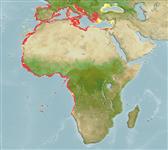
marinhas demersal; intervalo de profundidade 30 - 400 m (Ref. 5222). Subtropical; 46°N - 18°S, 19°W - 41°E
Eastern Atlantic: Portugal to Angola, including the Mediterranean.
Tamanho / Peso / Idade
Maturidade: Lm ? range ? - ? cm
Max length : 164 cm TL macho/indeterminado; (Ref. 89707); peso máx. Publicado: 35.0 kg (Ref. 5222)
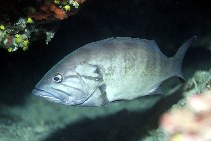
Espinhos dorsais (total) : 11; Raios dorsais moles (total) : 13 - 14; Espinhos anais: 3; Raios anais moles: 8. Distinguished by the following characteristics: uniformly dark reddish brown or greyish violet to yellowish grey; posterior parts of median fins with distinct white edge; 2-3 dark bands radiating posteriorly from the eye, uppermost extends from the eye to the lower opercular spine, 2nd runs from the lower edge of the eye across the angle of preopercle to the juncture of interopercle and subopercle, 3rd band extends from the dark mustache streak at the upper edge of the maxilla to the lower edge of preopercle; body depth 2.7-3.0 times in SL; head length 2.3-2.5 in SL; convex interorbital area; angular preopercle, 3-5 distinctly enlarged serrae at the angle and usually slender, antrorse or ventrally directed spine on ventral edge near the angle; serrate subopercle and interopercle; distinctly convex upper edge of operculum; posterior nostril is 2 or 3 times size of anterior nostril; scaly maxilla, reaching to or beyond vertical at rear edge of eye; 2 rows of teeth in midlateral part of lower jaw, inner teeth larger; well developed canines at front of jaws; caudal fin truncate, corners slightly rounded; body scales distinctly ctenoid, with numerous auxiliary scales (Ref. 089707).
Body shape (shape guide): fusiform / normal; Cross section: compressed.
Occurs on sandy mud bottoms (Ref. 3589). Feeds on fishes and invertebrates (Ref. 5506). Maximum weight of 78 kilograms reported by Jose Manuel, Spain (05/05).
Ciclo de vida e comportamento de acasalamento
Maturidade | Reprodução | Desova | Ovos | Fecundidade | Larvas
Heemstra, P.C. and J.E. Randall, 1993. FAO Species Catalogue. Vol. 16. Groupers of the world (family Serranidae, subfamily Epinephelinae). An annotated and illustrated catalogue of the grouper, rockcod, hind, coral grouper and lyretail species known to date. Rome: FAO. FAO Fish. Synop. 125(16):382 p. (Ref. 5222)
Categoria na Lista Vermelha da IUCN (Ref. 130435: Version 2025-2 (Global))
Ameaça para o homem
Harmless
Utilização humana
Pescarias: espécies comerciais
Ferramentas
Relatórios especiais
Descarregue XML
Fontes da internet
Estimativas baseadas em modelos
Temperatura preferida (Ref.
123201): 12.3 - 17.2, mean 14.9 °C (based on 180 cells).
Índice de diversidade filogenética (Ref.
82804): PD
50 = 0.5000 [Uniqueness, from 0.5 = low to 2.0 = high].
Bayesian length-weight: a=0.01148 (0.00555 - 0.02374), b=3.04 (2.87 - 3.21), in cm total length, based on LWR estimates for this Genus-body shape (Ref.
93245).
Nível Trófico (Ref.
69278): 3.8 ±0.55 se; based on food items.
Generation time: 28.2 ( na - na) years. Estimated as median ln(3)/K based on 1
growth studies.
Resiliência (Ref.
120179): Muito baixo, tempo mínimo de duplicação da população maior que 14 anos (Preliminary K or Fecundity.).
Vulnerabilidade da pesca (Ref.
59153): Very high vulnerability (87 of 100).
🛈
Nutrientes (Ref.
124155): Calcium = 22.5 [8.2, 54.4] mg/100g; Iron = 0.669 [0.308, 1.587] mg/100g; Protein = 18.2 [16.5, 19.9] %; Omega3 = 0.267 [0.136, 0.540] g/100g; Selenium = 52.6 [20.4, 126.8] μg/100g; VitaminA = 19.2 [4.0, 96.1] μg/100g; Zinc = 0.745 [0.455, 1.220] mg/100g (wet weight);