>
Blenniiformes (Blennies) >
Blenniidae (Combtooth blennies) > Salariinae
Etymology: Entomacrodus: Greek, ento = inside + Greek, makros = big + Greek, odous = teeth (Ref. 45335).
More on author: Valenciennes.
Ambiente: milieu / zona climatica / distribuzione batimetrica / gamma di distribuzione
Ecologia
marino associati a barriera corallina; distribuzione batimetrica 0 - 3 m (Ref. 86942). Tropical; 30°N - 32°S
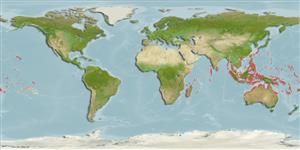
Indo-Pacific: East Africa to the Line and Ducie islands, north to the Ryukyu, Bonin, and Marcus islands (reported farther north to Wakayama Prefecture in Japan, Ref. 559), south to Lord Howe and Rapa islands.
Dimensione / Peso / Età
Maturità: Lm ? range ? - ? cm
Max length : 11.0 cm TL maschio/sesso non determinato; (Ref. 9710)
Breve descrizione
Chiavi di identificazione | Morfologia | Morfometria
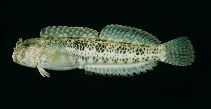
Spine dorsali (totale) : 12 - 14; Raggi dorsali molli (totale) : 14 - 16; Spine anali: 2; Raggi anali molli: 15 - 18. Small dark spots on body; upper lip uniformly dusky or with scattered spots; pale area behind eye followed by an irregular dark mark (Ref. 4404).
Body shape (shape guide): elongated.
Facultative air-breathing (Ref. 126274); Adults occur in the intertidal zone of lagoons and wave-swept seaward reefs (Ref. 9710). They inhabit holes of limestone matrix at low tide (Ref. 90102). At low tide they may be found in small pockets of water left in pitted limestone. Oviparous. Eggs are demersal and adhesive (Ref. 205), and are attached to the substrate via a filamentous, adhesive pad or pedestal (Ref. 94114). Larvae are planktonic, often found in shallow, coastal waters (Ref. 94114).
Ciclo vitale e comportamento di accoppiamento
Maturità | Riproduzione | Deposizione | Uova | Fecondità | Larve
Oviparous, distinct pairing (Ref. 205).
Myers, R.F., 1991. Micronesian reef fishes. Second Ed. Coral Graphics, Barrigada, Guam. 298 p. (Ref. 1602)
Stato della Lista Rossa IUCN (Ref. 130435: Version 2025-2 (Global))
Minaccia per l'uomo
Harmless
Usi umani
Pesca: commerciale; Acquario: Commerciale
Strumenti
Rapporti speciali
Scarica XML
Fonti Internet
Stime basate su modelli
Temperatura preferita (Fonte Biblio.
123201): 24.9 - 29.3, mean 28.4 °C (based on 2647 cells).
Indice di diversità filogenetica (Fonte Biblio.
82804): PD
50 = 0.5000 [Uniqueness, from 0.5 = low to 2.0 = high].
Bayesian length-weight: a=0.00776 (0.00354 - 0.01702), b=3.00 (2.81 - 3.19), in cm total length, based on LWR estimates for this (Sub)family-body shape (Ref.
93245).
Livello trofico (Fonte Biblio.
69278): 2.0 ±0.00 se; based on food items.
Resilienza (Fonte Biblio.
120179): Alto, tempo minimo di raddoppiamento della popolazione meno di 15 mesi (Preliminary K or Fecundity.).
Vulnerabilità della pesca (Ref.
59153): Low vulnerability (10 of 100).
🛈
Nutrienti (Ref.
124155): Calcium = 160 [76, 285] mg/100g; Iron = 0.847 [0.460, 1.523] mg/100g; Protein = 18 [17, 19] %; Omega3 = 0.0688 [, ] g/100g; Selenium = 17.5 [8.0, 41.4] μg/100g; VitaminA = 114 [27, 483] μg/100g; Zinc = 2.68 [1.71, 4.02] mg/100g (wet weight);