>
Gobiiformes (Gobies) >
Gobiidae (Gobies) > Gobiinae
Etymology: panamensis: Named for the country of origin.
Ambiente: milieu / zona climática / intervalo de profundidade / gama de distribuição
Ecologia
marinhas associadas(os) a recifes. Tropical
Distribuição
Territórios | Áreas FAO | Ecossistemas | Ocorrências | Mapa dos pontos | Introduções | Faunafri
Atlantic Ocean: known from the Atlantic coast of Panama from Colon to the San Blas Islands. The range extends eastward only into the adjacent Gulf of Urabá in Colombia (A. Acero pers. comm.) and confirmed reports extend westward only to the Costa Rican border (Robertson, pers. comm.) (Ref. 84089).
Tamanho / Peso / Idade
Maturidade: Lm ? range ? - ? cm
Max length : 2.3 cm SL macho/indeterminado; (Ref. 84089)
Descrição breve
Chaves de identificação | Morfologia | Morfometria
A species of Elacatinus with dorsal-fin elements VII, 11 (rare 12); anal-fin elements 10 (uncommon
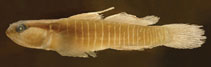
9); pectoral-fin rays 20–21 (19–21); pelvic fins fully-joined, short cup-like disk complete; no scales; a pale head with a prominent red stripe from the tip of the snout across the eye ending abruptly above the pectoral-fin base with a short orange segment, followed by a short black segment; a dark green body with 16–23 thin light green bars along the full length of the body.
Juveniles and adults of both sexes are similarly marked. The head is pale with a single prominent red stripe running from the tip of the snout across the eye ending abruptly above the pectoral-fin base with a short brightorange segment followed immediately by a short black segment. The background body color is an olive green, sometimes dark, with 16–23 thin green bars along the full length. The narrow bars usually run vertically over the full depth of the body, but many individuals have unique variations, such as bifurcations, cross-links, or breaks in a pattern reminiscent of fingerprint ridges (bars counted if greater than 1/3 of the full depth). The fins are mostly unmarked, but can be dusky.(Ref. 84089).
Body shape (shape guide): elongated.
Ciclo de vida e comportamento de acasalamento
Maturidade | Reprodução | Desova | Ovos | Fecundidade | Larvas
Victor, B.C., 2010. The Redcheek Paradox: the mismatch between genetic and phenotypic divergence among deeply-divided mtDNA lineages in a coral-reef goby, with the description of two new cryptic species from the Caribbean Sea. J. Ocean Sci. Found. 3:2-16. (Ref. 84089)
Categoria na Lista Vermelha da IUCN (Ref. 130435: Version 2025-2 (Global))
Ameaça para o homem
Harmless
Utilização humana
Ferramentas
Relatórios especiais
Descarregue XML
Fontes da internet
Estimativas baseadas em modelos
Índice de diversidade filogenética (Ref.
82804): PD
50 = 0.5000 [Uniqueness, from 0.5 = low to 2.0 = high].
Bayesian length-weight: a=0.00741 (0.00347 - 0.01582), b=3.09 (2.91 - 3.27), in cm total length, based on LWR estimates for this (Sub)family-body shape (Ref.
93245).
Nível Trófico (Ref.
69278): 3.1 ±0.3 se; based on size and trophs of closest relatives
Vulnerabilidade da pesca (Ref.
59153): Low vulnerability (10 of 100).
🛈