>
Clupeiformes (Herrings) >
Dussumieriidae (Round herrings)
Etymology: Dussumieria: In honor of Dussumier, a collaborator of Cuvier, who sent him collections of fishes from the Indian Ocean (Ref. 45335); torpedo: Named for its subcylindrical body (Ref. 127774).
Eponymy: Jean-Jacques Dussumier (1792–1883) was a French merchant, collector, traveller and ship owner. [...] (Ref. 128868), visit book page.
Ambiente: milieu / zona climática / intervalo de profundidade / gama de distribuição
Ecologia
marinhas pelagic-neritic. Tropical
Western Indian Ocean: east coast of Africa.
Tamanho / Peso / Idade
Maturidade: Lm ? range ? - ? cm
Max length : 14.1 cm SL macho/indeterminado; (Ref. 127774)
Descrição breve
Chaves de identificação | Morfologia | Morfometria
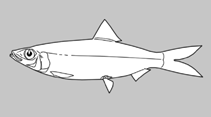
This species is distinguished by the following characters: branchiostegal rays 12-16; premaxillae rectangular, the isthmus pointed anteriorly; pelvic scute W-shaped; pelvic fin located below the dorsal-fin base; A 13-17 rays; abdomen without keeled scutes; differs from its congeners by having small pores on the posterior region of the body scales (vs. numerous longitudinal striae in D. acuta, D. albulina and no striae or pores D. elopsoides; differs from elopsoides in having a deeper body 20.0-24.2% of SL (vs. 16-22%); differs from acuta in having a narrower body 20.0-24.2% of SL (vs. 23.4-28.2% in individuals > 7.5 cm SL of acuta), indistinct melanophores scattered on the 6th-9th pectoral-fin rays from the uppermost ray (vs. distinct on the 1st-5th pectoral-fin rays from the uppermost ray), and without parasphenoid teeth (vs. several rows of distinct conical parasphenoid teeth); most similar to albulina by having a relatively deep body (> 20.0% of SL) and without parasphenoid teeth but it differs by having small pores posteriorly on the body scales (vs. numerous longitudinal striae posteriorly in albulina), with a longer maxilla 33.4-34.9% of HL (vs. 30.4-34.9% [< 33.3% in specimens > 8.5 cm SL]) and the mandible 48.5-51.9% of HL (vs. 44.8-50.6%), has a greater number of pseudobranchial filaments 19-23 (vs. 17-21), and indistinct melanophores scattered on the pectoral-fin rays (vs. distinct) (Ref. 127774).
Cross section: compressed.
Ciclo de vida e comportamento de acasalamento
Maturidade | Reprodução | Desova | Ovos | Fecundidade | Larvas
Hata, H., S. Lavoué and H. Motomura, 2021. New rainbow sardine species of Dussumieria (Teleostei: Clupeiformes: Dussumieriidae) from the East African coast. Ichthyology & Herpetology 109(4):991-997. (Ref. 127774)
Categoria na Lista Vermelha da IUCN (Ref. 130435: Version 2025-2 (Global))
Ameaça para o homem
Harmless
Utilização humana
Pescarias: pouco comercial
Ferramentas
Relatórios especiais
Descarregue XML
Fontes da internet
Estimativas baseadas em modelos
Índice de diversidade filogenética (Ref.
82804): PD
50 = 0.5020 [Uniqueness, from 0.5 = low to 2.0 = high].
Bayesian length-weight: a=0.00933 (0.00426 - 0.02047), b=3.03 (2.84 - 3.22), in cm total length, based on LWR estimates for this (Sub)family-body shape (Ref.
93245).
Nível Trófico (Ref.
69278): 3.4 ±0.4 se; based on size and trophs of closest relatives
Resiliência (Ref.
120179): Elevada, tempo mínimo de duplicação da população menor que 15 meses (Preliminary K or Fecundity.).
Vulnerabilidade da pesca (Ref.
59153): Low vulnerability (10 of 100).
🛈