>
Eupercaria/misc (Various families in series Eupercaria) >
Moronidae (Temperate basses)
Etymology: Dicentrarchus: Greek, di = two + Greek, kentron = sting + Greek, archos = anus (Ref. 45335).
More on author: Linnaeus.
Meio ambiente: milieu / Zona climática / intervalo de profundidade / faixa de distribuição
Ecologia
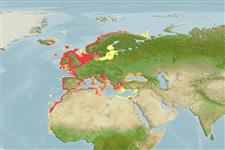
marinhas; Água doce; estuarina demersal; catádromo (Ref. 138297); intervalo de profundidade 10 - 100 m (Ref. 9987). Subtropical; 8°C - 24°C (Ref. 4944); 72°N - 11°N, 19°W - 42°E (Ref. 54221)
NE Atlantic Ocean (Morocco to Norway, including the British Isles); the Mediterranean and southern Black Sea basins; occasional records of vagrant individuals from the Baltic Sea and Atlantic coastline of North Africa as far south as Senegal; with recent records suggesting it has invaded the northern Red Sea basin via the Suez Canal.
Comprimento de primeira maturação / Tamanho / Peso / Idade
Maturidade: Lm 36.1, range 23 - 46 cm
Max length : 103 cm TL macho/indeterminado; (Ref. 40637); common length : 50.0 cm TL macho/indeterminado; (Ref. 6916); peso máx. publicado: 12.0 kg (Ref. 1468); idade máx. registrada: 30 anos (Ref. 59043)
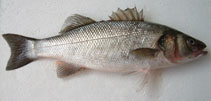
Espinhos dorsais (total) : 8 - 10; Raios dorsais (total) : 12 - 13; Espinhos anais: 3; Raios anais : 10 - 12. Diagnosis: head with cycloid scales above; mouth moderately protractile (Ref. 231). Vomerine teeth only anteriorly (Ref. 231), in a crescentic band (Ref. 231, 57391). Scales on interorbital space cycloid (Ref. 57391). Posterior edge of opercle finely serrated, lower edge with strong forward- directed denticles (Ref. 231). 2 flat opercular spines (Ref. 231, 57391). Young with some dark spots on upper part of body (Ref. 231).
Body shape (shape guide): fusiform / normal.
Adults manifest demersal behavior, inhabit coastal waters down to about 100 m depth but more common in shallow waters (Ref. 54221, 57391). Found in the littoral zone on various kinds of bottoms on estuaries, lagoons and occasionally rivers. They enter coastal waters and river mouths in summer, but migrate offshore in colder weather and occur in deep water during winter in the northern range. Young fish form school, but adults appear to be less gregarious (Ref. 9987). Feed chiefly on shrimps and mollusks, also on fishes (Ref. 5990). Juveniles feed on invertebrates, taking increasingly more fish with age. Adults piscivorous . (Ref. 59043). Spawn in batches (Ref. 51846). Spawning takes place in the spring near the British Isles, and earlier in its southern range. Eggs are pelagic (Ref. 35388). Marketed fresh or smoked (Ref. 9987). Highly sought by sport fishermen (Ref. 30578).
Spawn in groups. Eggs are pelagic. In the Mediterranean, first sexual maturity occurs generally between 2 and 4 years of age while in the Atlantic sexual maturity happens a little later (males between 4-7 years and females between 5-8 years). Spawning happens just once a year and it tends to be in winter, although in southern areas it can occur in spring. Eggs have 1-2 fat drops that fuse about 12 hours after laying. Embryo development lasts about three days at 13-14°C and larval development about 40 days at 19°C. Egg size 1.1-1.5 mm, larval length at hatching 3 mm.
Smith, C.L., 1990. Moronidae. p. 692-694. In J.C. Quero, J.C. Hureau, C. Karrer, A. Post and L. Saldanha (eds.) Check-list of the fishes of the eastern tropical Atlantic (CLOFETA). JNICT, Lisbon; SEI, Paris; and UNESCO, Paris. Vol. 2. (Ref. 6916)
Status na Lista Vermelha da UICN (Ref. 130435: Version 2025-2 (Global))
Ameaça para os humanos
Harmless
Uso pelos humanos
Pescarias: espécies comerciais; Aquacultura: espécies comerciais; peixe esportivo: sim
Ferramentas
Relatórios especiais
Baixar XML
Fontes da internet
Estimativas baseadas em modelos
Temperatura preferida (Ref.
123201): 7.3 - 19.5, mean 10.7 °C (based on 788 cells).
Índice de diversidade filogenética (Ref.
82804): PD
50 = 0.7656 [Uniqueness, from 0.5 = low to 2.0 = high].
Bayesian length-weight: a=0.00933 (0.00776 - 0.01123), b=3.02 (2.96 - 3.08), in cm total length, based on LWR estimates for this species (Ref.
93245).
Nível Trófico (Ref.
69278): 3.5 ±0.50 se; based on food items.
Generation time: 7.8 (5.0 - 11.0) years. Estimated as median ln(3)/K based on 33
growth studies.
Resiliência (Ref.
120179): Baixo, tempo mínimo de duplicação da população 4,5 - 14 anos (K=0.06-0.33; tm=2-8; tmax=30; Fec=230,000).
Prior r = 0.37, 95% CL = 0.25 - 0.56, Based on 10 full stock assessments.
Vulnerabilidade da pesca (Ref.
59153): High to very high vulnerability (66 of 100).
🛈
Vulnerabilidade climática (Ref.
125649): Moderate to high vulnerability (47 of 100).
🛈
Nutrientes (Ref.
124155): Calcium = 37.1 [4.5, 189.2] mg/100g; Iron = 0.869 [0.355, 2.011] mg/100g; Protein = 20.2 [19.3, 21.1] %; Omega3 = 0.3 [0.2, 0.5] g/100g; Selenium = 14.6 [7.0, 32.5] μg/100g; VitaminA = 7.01 [2.63, 20.46] μg/100g; Zinc = 0.519 [0.256, 1.128] mg/100g (wet weight); based on
nutrient studies.