>
Gobiiformes (Gobies) >
Gobiidae (Gobies) > Gobiinae
Etymology: Cryptocentrus: Greek, kryptos = hidden + Greek, kentron = sting (Ref. 45335); epakros: Name from Greel 'epakros' meaning pointed at the end; referring to the diagnostic anal fin
shape, consisting of elongated seventh and eighth fin rays that result in a conspicuous pointed posterior fin profile.
Ambiente: milieu / zona climatica / distribuzione batimetrica / gamma di distribuzione
Ecologia
marino benthopelagico; distribuzione batimetrica 12 - 15 m (Ref. 116711). Tropical
Western Pacific: Papua New Guinea.
Dimensione / Peso / Età
Maturità: Lm ? range ? - ? cm
Max length : 5.0 cm SL maschio/sesso non determinato; (Ref. 116711); 3.4 cm SL (female)
Breve descrizione
Chiavi di identificazione | Morfologia | Morfometria
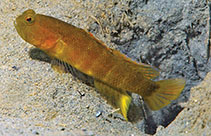
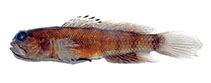
Spine dorsali (totale) : 7; Raggi dorsali molli (totale) : 10; Spine anali: 1; Raggi anali molli: 9. Dorsal-fin rays VI-I,10; anal-fin rays I,9; pectoral-fin rays 15; scales in longitudinal series 47; median predorsal scales 19; body scales entirely cycloid, including abdomen, and prepelvic region; pectoral-fin base and head naked except side of nape and predorsal region; preopercular-canal pore N absent; gill opening extending forward to a vertical at posterior edge of preopercle; seventh and eighth anal-fin rays prolonged, resulting in distinctly pointed posterior anal-fin profile; longest anal-fin rays 1.1 in HL; caudal fin rounded, longer than head, 3.1 in SL; pelvic fins relatively short, not reaching posteriorly to anus, 4.7 in SL; color of female generally golden brown with six faint dark bars from nape to caudal-fin base, interspersed with yellowish, slightly narrower interspaces; both dorsal fins with vertical, dark-edged orange markings between each spine and ray, interrupted to form spots on outer half of fin; second dorsal fin with pale blue submarginal stripe; anal fin dusky yellow brown, except posteriormost portion (encompassing last three rays) bright yellow; caudal fin is yellow to brownish with longitudinal blue streak between most rays of middle portion; pelvic-fin rays are dusky brownish; male (not collected, but presumed to be the same species) with 4 oblique and narrow orange bands (usually wavy and interrupted) on the cheek and opercle and have more vivid dark bars on body (Ref. 116711).
Body shape (shape guide): elongated; Cross section: compressed.
The area of collection consists of moderately sloped (ca.20 degrees) mud substratum, where the slope begins in approximately 1.5 m depth and flattens out at about 18 m. The featureless bottom have numerous burrows occupied by a variety of fishes and invertebrates, including Cryptocentrus epakros. Three individuals (the female holotype, a presumed male, and another female) were observed in 12.5-15.0 m depth. Each individual was invariably associated with an unidentified alpheid shrimp (colour overall is pale greyish with bright pink legs and a pink claw with a bluish tip). The female holotype was in close proximity (about 30 cm) to the presumed male, which occupied a separate burrow (Ref. 116711).
Ciclo vitale e comportamento di accoppiamento
Maturità | Riproduzione | Deposizione | Uova | Fecondità | Larve
Allen, G.R., 2015. Descriptions of two new gobies species of shrimpgobies (Gobiidae: Cryptocentrus and Tomiyamichthys) from Papua New Guinea. J. Ocean Sci. Found. 16:67-81. (Ref. 116711)
Stato della Lista Rossa IUCN (Ref. 130435: Version 2025-2 (Global))
Minaccia per l'uomo
Harmless
Usi umani
Strumenti
Rapporti speciali
Scarica XML
Fonti Internet
Stime basate su modelli
Indice di diversità filogenetica (Fonte Biblio.
82804): PD
50 = 0.5000 [Uniqueness, from 0.5 = low to 2.0 = high].
Bayesian length-weight: a=0.00741 (0.00347 - 0.01582), b=3.09 (2.91 - 3.27), in cm total length, based on LWR estimates for this (Sub)family-body shape (Ref.
93245).
Livello trofico (Fonte Biblio.
69278): 3.2 ±0.3 se; based on size and trophs of closest relatives
Resilienza (Fonte Biblio.
120179): Alto, tempo minimo di raddoppiamento della popolazione meno di 15 mesi (Preliminary K or Fecundity.).
Vulnerabilità della pesca (Ref.
59153): Low vulnerability (10 of 100).
🛈