Classificazione / Nomi
Nomi Comuni | Sinonimi | Catalog of Fishes(Genere, Specie) | ITIS | CoL | WoRMS | Cloffa
>
Gobiiformes (Gobies) >
Gobiidae (Gobies) > Gobiinae
Etymology: nanus: Name from the Latin 'nanus' meaning small or dwarf, referring to the species' small size among Coryogalops species.
Ambiente: milieu / zona climatica / distribuzione batimetrica / gamma di distribuzione
Ecologia
marino pelagic-neritic; distribuzione batimetrica 1 - 3 m (Ref. 116571). Tropical
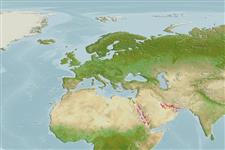
Western Indian Ocean: Red Sea, Saudi Arabia and Egypt .
Dimensione / Peso / Età
Maturità: Lm ? range ? - ? cm
Max length : 1.5 cm SL maschio/sesso non determinato; (Ref. 116571)
Breve descrizione
Chiavi di identificazione | Morfologia | Morfometria
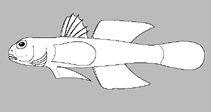
Spine dorsali (totale) : 7; Raggi dorsali molli (totale) : 10; Spine anali: 1; Raggi anali molli: 9. This species is distinguished by the following characters: D VI + I,10; A I,9; pectoral-fin rays 12?14, the 2 upper rays with free tips; pelvic fins I,5, joined to form a disc which is emarginate (the shortest branches of fifth ray about 2/3?3/4 length of longest branches of fourth ray), no pelvic frenum; naked predorsal area and area at base of first dorsal fin; longitudinal scale series 26-29; transverse scale series counted forward 6-7, reaching naked area at first dorsal-fin base; transverse scale series counted backward 7-8; circumpeduncular scale rows 11-12; head with 7 transverse suborbital rows of sensory papillae; without tentacle above upper eye margin; anterior nostril is tubular, without flap at its tip, posterior nostril pore-like; semi-translucent body with small scattered orange-yellow spots and speckles, spots in predorsal area and a few midlaterally on body containing black dots; ventral part of body with a row of internal white spots above anal-fin base and on caudal peduncle; head and prepectoral area with small scattered orange to yellowish brown spots; first dorsal fin with 2 broad white bands at the base of fin and distally, middle of fin hyaline densely dotted with melanophores; colour of preserved specimen opaque white to yellowish with sparse melanophores (Ref. 116571).
Body shape (shape guide): elongated; Cross section: oval.
This species were collected on a patch of rubble-sand bottom in less than one meter to 3 meters deep; found among shells sparsely covering the patch. More material and data are needed to check the relationship of this species to shells and their use as shelters (Ref. 116571).
Ciclo vitale e comportamento di accoppiamento
Maturità | Riproduzione | Deposizione | Uova | Fecondità | Larve
Kovačić, M., S.V. Bogorodsky and A.O. Mal, 2016. A new species of Coryogalops (Perciformes: Gobiidae) and the first adult record of Feia nympha from the Red Sea. Zootaxa 4097(3):341-352. (Ref. 116571)
Stato della Lista Rossa IUCN (Ref. 130435: Version 2025-2 (Global))
Minaccia per l'uomo
Harmless
Usi umani
Strumenti
Rapporti speciali
Scarica XML
Fonti Internet
Stime basate su modelli
Indice di diversità filogenetica (Fonte Biblio.
82804): PD
50 = 0.5002 [Uniqueness, from 0.5 = low to 2.0 = high].
Bayesian length-weight: a=0.00741 (0.00347 - 0.01582), b=3.09 (2.91 - 3.27), in cm total length, based on LWR estimates for this (Sub)family-body shape (Ref.
93245).
Livello trofico (Fonte Biblio.
69278): 3.0 ±0.3 se; based on size and trophs of closest relatives
Resilienza (Fonte Biblio.
120179): Alto, tempo minimo di raddoppiamento della popolazione meno di 15 mesi (Preliminary K or Fecundity.).
Vulnerabilità della pesca (Ref.
59153): Low vulnerability (10 of 100).
🛈