>
Beloniformes (Needle fishes) >
Scomberesocidae (Sauries)
Etymology: Cololabis: Greek, kolos = short, truncated + Latin, labia = lips (Ref. 45335); saira: From the Japanese word 'saira' meaning spear (Ref. 6885).
Ambiente: milieu / zona climatica / distribuzione batimetrica / gamma di distribuzione
Ecologia
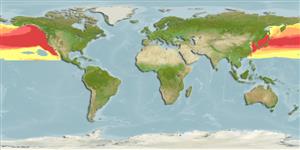
marino pelagic-oceanic; oceanodromo (Ref. 87829); distribuzione batimetrica 0 - 230 m (Ref. 9339). Subtropical; 67°N - 18°N, 117°E - 108°W (Ref. 54338)
North Pacific: Korea (Ref. 37630) and Japan eastward to Gulf of Alaska and southward to Mexico. Highly migratory species.
Lunghezza alla prima maturità / Dimensione / Peso / Età
Maturità: Lm 23.7, range 25 - 28 cm
Max length : 40.0 cm SL maschio/sesso non determinato; (Ref. 39882); peso massimo pubblicato: 180.00 g (Ref. 56527); Età massima riportata: 4 anni (Ref. 72462)
Breve descrizione
Chiavi di identificazione | Morfologia | Morfometria
Spine dorsali (totale) : 0; Raggi dorsali molli (totale) : 9 - 12; Spine anali: 0; Raggi anali molli: 12 - 15; Vertebre: 62 - 69. Caudal fin broadly and finely forked; pectorals small, truncate, first ray notably flattened (Ref. 6885). Dark green to blue on dorsal surface, silvery below, small bright blue blotches distributed haphazardly on sides; fins on lower part of body pale, others with darkened rays (Ref. 6885). Branchiostegal rays: 12-15 (Ref. 36573).
Body shape (shape guide): elongated.
Adults are generally found offshore, usually near surface, in schools (Ref. 2850). Juveniles associate with drifting seaweed (Ref. 12114, 12115). Feed on small crustaceans, and eggs and larvae of fishes. May glide above the surface of the water when moving away from predators. Prey of Thunnus alalunga and other scombrids (Ref. 9339). Oviparous, with larvae neustonic (Ref. 36573). Eggs are attached to one another and to floating objects via filaments on the shell surface (Ref. 36573). Utilized dried or salted, canned and frozen; also used for fishmeal and pet food; can be pan-fried and broiled (Ref. 9988).
Eschmeyer, W.N., E.S. Herald and H. Hammann, 1983. A field guide to Pacific coast fishes of North America. Boston (MA, USA): Houghton Mifflin Company. xii+336 p. (Ref. 2850)
Stato della Lista Rossa IUCN (Ref. 130435: Version 2025-2 (Global))
Minaccia per l'uomo
Harmless
Usi umani
Pesca: elevato interesse commerciale
Strumenti
Rapporti speciali
Scarica XML
Fonti Internet
Stime basate su modelli
Temperatura preferita (Fonte Biblio.
123201): 4.6 - 14.8, mean 8 °C (based on 99 cells).
Indice di diversità filogenetica (Fonte Biblio.
82804): PD
50 = 0.7812 [Uniqueness, from 0.5 = low to 2.0 = high].
Bayesian length-weight: a=0.00240 (0.00125 - 0.00459), b=3.15 (2.96 - 3.34), in cm total length, based on LWR estimates for this species & (Sub)family-body (Ref.
93245).
Livello trofico (Fonte Biblio.
69278): 3.7 ±0.44 se; based on food items.
Resilienza (Fonte Biblio.
120179): Alto, tempo minimo di raddoppiamento della popolazione meno di 15 mesi (K=0.3-0.6; tmax=2).
Prior r = 0.94, 95% CL = 0.62 - 1.41, Based on 2 data-limited stock assessments.
Vulnerabilità della pesca (Ref.
59153): Low to moderate vulnerability (32 of 100).
🛈
Vulnerabilità climatica (Ref.
125649): Low vulnerability (25 of 100).
🛈
Nutrienti (Ref.
124155): Calcium = 162 [60, 372] mg/100g; Iron = 1.51 [0.75, 3.55] mg/100g; Protein = 17.6 [15.5, 19.6] %; Omega3 = 0.407 [0.193, 1.210] g/100g; Selenium = 31 [15, 63] μg/100g; VitaminA = 19 [6, 70] μg/100g; Zinc = 0.738 [0.515, 1.100] mg/100g (wet weight);