>
Siluriformes (Catfishes) >
Clariidae (Airbreathing catfishes)
Etymology: Clarias: Greek, chlaros = lively, in reference to the ability of the fish to live for a long time out of water.
More on author: Sauvage.
Ambiente: milieu / zona climatica / distribuzione batimetrica / gamma di distribuzione
Ecologia
; acqua dolce demersale; pH range: 6.0 - 7.5; dH range: 15 - 25; potamodromo (Ref. 51243). Tropical; 22°C - 28°C (Ref. 12468); 10°N - 11°S
Africa: from coastal rivers of Benin and Nigeria over rivers Cross, Sanaga, Wouri and Ogooué (Cameroon and Gabon) to the Congo River basin (Democratic Republic of the Congo, Angola, Congo Republic, Central African Republic and Zambia) (Ref. 248).
Dimensione / Peso / Età
Maturità: Lm ? range ? - ? cm
Max length : 34.1 cm TL maschio/sesso non determinato; (Ref. 11363)
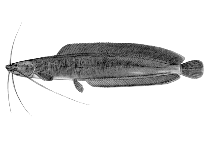
Spine dorsali (totale) : 0; Raggi dorsali molli (totale) : 75 - 88; Spine anali: 0; Raggi anali molli: 55 - 68; Vertebre: 56 - 63. Diagnosis: head relatively broad, 14.2-20.9% of standard length (Ref. 57129, 81644). Head length 21.0-27.9% SL (Ref. 101841). Wide interorbital distance (Ref. 248), 41.3-51.8% averaging 46.4% of head length (Ref. 57129, 81644). Large tooth plates (Ref. 248), width of premaxillary tooth plate 25.9-37.2% of head length (m=29.5), width of vomerine tooth plate 21.0-31.2% of head length (Ref. 57129, 81644). Barbels extremely long (Ref. 248, 57129, 81644), nasal barbel 77.8-187.5%, maxillary barbel 142.9-305.8%, inner mandibular barbell 58.9-128.7%, and outer mandibular barbell 104.3-211.2% of head length (Ref. 57129, 81644). Head rather rectangular in dorsal outline; eyes more laterally located (Ref. 248). Frontal fontanelle long and narrow ("knife-shaped")(Ref. 248, 57129). Occipital fontanelle oval-shaped; pectoral spine robust and slightly curved (Ref. 248), strongly serrated on outside and inside (Ref. 81644, 101841). Gill rakers on first branchial arch long and slender; suprabranchial organ well developed, however not completely filling the cavity (Ref. 248). Openings of secondary canals of lateral line irregularly placed on the body (Ref. 248, 81644). Cleithrum mostly embedded in soft tissue, only thin bony ridge is exposed through skin; dorsal fin length 61.5-73.0% SL; distance from dorsal to caudal fin -1.4-2.1% SL (Ref. 101841).
Colouration: both live and preserved specimens usually dark-coloured (Ref. 57129, 81644, 101841). 2 types of colouration: one uniform dark brown to black on back and sides and light on belly (Ref. 57129, 81644, 101841), and upper sides of paired fins dark on lower sides and light on upper sides (Ref. 248). The other marbled, with small brown spots against a light background on back and sides and belly whitish; very dark unpaired fins; caudal fin with a series of vertical bars (a light bar in the middle flanked by dark ones)(Ref. 248, 57129, 81644, 101841). Some specimens may show irregular pattern of small white spots on body (Ref. 101841).
Body shape (shape guide): elongated; Cross section: oval.
Facultative air-breathing (Ref. 126274); Found in lakes, rivers, floodplains and swamps. Bottom feeder, the stomach contained plants, algae, insect larvae (Ephemeroptera, Chironomidae, Ceratopogonidae, Odonata), Entomostraca (Cladocera, Ostracoda), Thecamiba and remains of insects (Ref. 248).
Ciclo vitale e comportamento di accoppiamento
Maturità | Riproduzione | Deposizione | Uova | Fecondità | Larve
Teugels, G.G., 1986. A systematic revision of the African species of the genus Clarias (Pisces; Clariidae). Ann. Mus. R. Afr. Centr., Sci. Zool., 247:199 p. (Ref. 248)
Stato della Lista Rossa IUCN (Ref. 130435: Version 2025-2 (Global))
Minaccia per l'uomo
Harmless
Usi umani
Strumenti
Rapporti speciali
Scarica XML
Fonti Internet
Stime basate su modelli
Indice di diversità filogenetica (Fonte Biblio.
82804): PD
50 = 0.5000 [Uniqueness, from 0.5 = low to 2.0 = high].
Bayesian length-weight: a=0.00851 (0.00535 - 0.01355), b=2.95 (2.82 - 3.08), in cm total length, based on LWR estimates for this species & Genus-body shape (Ref.
93245).
Livello trofico (Fonte Biblio.
69278): 3.3 ±0.41 se; based on food items.
Resilienza (Fonte Biblio.
120179): Alto, tempo minimo di raddoppiamento della popolazione meno di 15 mesi (Preliminary K or Fecundity.).
Vulnerabilità della pesca (Ref.
59153): Low vulnerability (24 of 100).
🛈
Nutrienti (Ref.
124155): Calcium = 42.4 [20.5, 211.6] mg/100g; Iron = 1.66 [0.95, 2.88] mg/100g; Protein = 16.7 [15.7, 17.8] %; Omega3 = 0.257 [0.086, 0.727] g/100g; Selenium = 119 [41, 307] μg/100g; VitaminA = 37.7 [13.4, 106.1] μg/100g; Zinc = 0.986 [0.680, 1.402] mg/100g (wet weight);