Clasificación / Nombres
Nombres comunes | Sinónimos | Catalog of Fishes(Género, Especie) | ITIS | CoL | WoRMS | Cloffa
>
Characiformes (Characins) >
Stevardiidae (Stevardiids) > Stevardiinae
Etymology: Chrysobrycon: Greek, chrysos = golden + Greek, ebryko = to bite; calamar: Name 'calamar' from the type locality of the species, Calamar. Noun in apposition.
Entorno: milieu / zona climática / rango de profundidad / gama de distribución
Ecología
; agua dulce pelágico. Tropical
South America: Colombia.
Tamaño / Peso / Edad
Madurez: Lm ? range ? - ? cm
Max length : 4.1 cm SL macho / no sexado; (Ref. 133163)
Descripción breve
Claves de identificación | Morfología | Morfometría
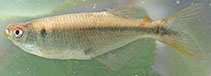
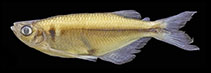
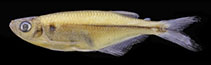
Radios blandos dorsales (total) : 8 - 9; Radios blandos anales: 24 - 29; Vértebra: 43. This species is distinguished from its congeners by the following set of characters: a distinctive dark vertical blotch placed laterally on the abdominal flanks in adult males, just immediately dorsal to the urogenital region; a well-developed vertically humeral blotch in adult males; possession of numerous (2-12) tiny bony hooks on nearly all the upper lobe caudal-fin rays in adult males; number of vertebrae 43; posterior portion of the maxilla not reaching the vertical through the anterior border of the eye when the mouth is closed; an elongated maxillary anterior process, representing proportionally 40% or more of the total length of the bone; bony hooks in adult males on nearly all the branched anal-fin rays present; simple terminal lateral-line tube present between the caudal-fin rays 11 and 12; number of circumpeduncular scales 13-14; distance between dorsal- and adipose-fin origins 20.4-24.4% SL, dorsal-fin to caudal-fin base 33.0-39.6% SL, eye to dorsal-fin origin 51.9-57.2% SL; upper jaw length 38.1-45.5% HL; maximum number of cusps on the maxillary teeth tricuspid; number of supraneurals 11; number of dentary teeth 13-17; number of radii on the lateral-line scales 5-9; number of maxillary teeth 2-4; shape of the distal tips of most maxillary teeth straight along their lengths; depth at dorsal-fin origin 27.5-33.5% SL; distance between dorsal- and adipose-fin origins 20.4-24.4% SL (Ref 133163).
Body shape (shape guide): elongated; Cross section: compressed.
The species inhabits shallow, clear, black water (< 1 m) with moderate flow, and a substrate composed of sand, pebbles, and rocks. Its diet composed of aquatic and terrestrial invertebrates, mainly the remains of Diptera, Lepidoptera, Formicidae.
The species occurs in the main tributaries of the upper Vaupés (Río Itilla and Río Unilla basins) and nearby drainages at elevations of 250-270 meters. In the Río Itilla, water conditions include a temperature of 25.7 °C, high dissolved oxygen (7.99 mg/L), slightly acidic pH (6.5), and low conductivity (14.0 µS/cm) (Ref. 133163).
Ciclo vital y comportamiento de apareamiento
Madurez | Reproducción | Puesta | Huevos | Fecundidad | Larva
Vanegas-Ríos, J.A., A. Urbano-Bonilla and G.C. Sánchez-Garcés, 2024. A new species of Chrysobrycon Weitzman & Menezes, 1998 (Characiformes, Characidae, Stevardiinae) with remarkable sexually dimorphic pigmentation from the upper Río Vaupés basin, Colombian Amazon, with taxonomic key. Zoosyst. Evol. 100(2):675-689. (Ref. 133163)
Situación en la Lista Roja de la UICN (Ref. 130435: Version 2025-2 (Global))
Amenaza para el ser humano
Harmless
Usos humanos
Herramientas
Informes especiales
Descargar XML
Fuentes de Internet
Estimaciones basadas en modelos
Índice de diversidad filogenética (Referencia
82804): PD
50 = 0.5156 [Uniqueness, from 0.5 = low to 2.0 = high].
Bayesian length-weight: a=0.00389 (0.00180 - 0.00842), b=3.12 (2.94 - 3.30), in cm total length, based on all LWR estimates for this body shape (Ref.
93245).
Nivel trófico (Referencia
69278): 3.0 ±0.4 se; based on size and trophs of closest relatives
Vulnerabilidad pesquera (Ref.
59153): Low vulnerability (10 of 100).
🛈