Ambiente: milieu / zona climática / intervalo de profundidade / gama de distribuição
Ecologia
; Água doce bentopelágico; intervalo de profundidade 0 - 1 m (Ref. 127648). Tropical
Asia: Sri Lanka.
Tamanho / Peso / Idade
Maturidade: Lm ? range ? - ? cm
Max length : 65.0 cm SL macho/indeterminado; (Ref. 127648)
Descrição breve
Chaves de identificação | Morfologia | Morfometria
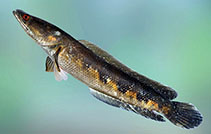
Raios dorsais moles (total) : 47 - 48; Raios anais moles: 29 - 30; Vértebras: 56. This species is distinguished from C. marulius, C. aurolineata, C. auroflammea by having fewer vertebrae 56 (vs. 59-63 in marulius; 63-66 in aurolineata; 58-61 in auroflammea); fewer lateral-line scales 59-62 (vs. 62-65 in marulius; 65-71 in aurolineata; 61-65 in auroflammea); fewer dorsal-fin rays 47-48 (vs. 50-56 in marulius; 55-58 in aurolineata; 52-54 in auroflammea); and fewer anal-fin rays 29-30 (vs. 32-37 in marulius; 35-38 in aurolineata; 33-36 in auroflammea); distinguished from aurolineata and C. marulioides by the white spots along mid-lateral blotches faint or absent (vs, series of black scales rimmed in white along the mid-lateral dark blotches) in live adults; differs to South Indian C. pseudomarulius, by having more vertebrae 56 (vs. 55) and having more circumpeduncular scales 26-28 (vs. 24); differs C. cf. ara from the southwestern wet zone of Sri Lanka by having more circumpeduncular scales 26-28 (vs. 22-24); by the absence or faintness of the numerous large white spots along the mid-lateral dark blotches (vs. presence of spots in C. cf. ara) and by bright orange colouration in between the mid-lateral series of dark brown blotches when alive (vs white to yellow colouration)(Ref. 127648).
Cross section: compressed.
This species occurs primarily in the deep pools in the Mahaweli River and its tributaries. Also recorded from reservoirs in the Mahaweli catchment (Victoria and Randenigala). Around 20 juveniles (ca. 8.0-10.0 cm SL), guarded by a pair of adults, were observed in shallow water (ca. 60-80 cm deep), among submerged roots, close to the bank, at the mouth of a stream draining into Badulu Oya of the Mahaweli basin. The highest recorded elevation from which this species was found was about 500 m asl at Kandy (Ref. 127648).
Ciclo de vida e comportamento de acasalamento
Maturidade | Reprodução | Desova | Ovos | Fecundidade | Larvas
Sudasinghe, H., E.A.S. Adamson, T. Ranasinghe, M. Meegaskumbura, C. Ikebe and R. Britz, 2020. Unexpected species diversity within Sri Lanka’s snakehead fishes of the Channa marulius group (Teleostei: Channidae). Zootaxa 4747(1):113-132. (Ref. 127648)
Categoria na Lista Vermelha da IUCN (Ref. 130435: Version 2025-2 (Global))
Ameaça para o homem
Harmless
Utilização humana
Pescarias: espécies comerciais
Ferramentas
Relatórios especiais
Descarregue XML
Fontes da internet
Estimativas baseadas em modelos
Índice de diversidade filogenética (Ref.
82804): PD
50 = 0.5000 [Uniqueness, from 0.5 = low to 2.0 = high].
Bayesian length-weight: a=0.00813 (0.00372 - 0.01775), b=2.98 (2.81 - 3.15), in cm total length, based on LWR estimates for this Genus-body shape (Ref.
93245).
Nível Trófico (Ref.
69278): 4.1 ±0.7 se; based on size and trophs of closest relatives
Resiliência (Ref.
120179): Médio, tempo mínimo de duplicação da população 1,4 - 4,4 anos (Preliminary K or Fecundity.).
Vulnerabilidade da pesca (Ref.
59153): Moderate to high vulnerability (52 of 100).
🛈