Ikan bertulang rawan (sharks and rays) >
Carcharhiniformes (Ground sharks) >
Carcharhinidae (Requiem sharks)
Etymology: Carcharhinus: karcharos (Gr.), sharp or jagged; rhinus, an ancient name for sharks, from rhine (Gr.), rasp, both words alluding to a shark's jagged, rasp-like skin (See ETYFish); macloti: In honor of German naturalist Heinrich Christian Macklot (1799-1832, Latinized as Maclot), who collected holotype in New Guinea (See ETYFish).
Eponymy: Heinrich Christian Macklot (1799–1832) was a German naturalist and taxidermist. [...] (Ref. 128868), visit book page.
More on authors: Müller & Henle.
Lingkungan: lingkungan / zona iklim / kisaran kedalaman / jangkauan distribusi
Ekologi
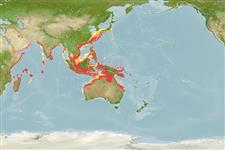
laut dasar (demersal); kisaran kedalaman ? - 170 m (Ref. 6871). Subtropical; 37°N - 27°S, 39°E - 154°E
Indo-West Pacific: Kenya, Tanzania, Pakistan, India, Sri Lanka, Andaman Sea, Myanmar, Viet Nam, China, Taiwan, Hong Kong and the Philippines (Ref. 6821), New Guinea. Also in the Arafura Sea (Ref. 9819). Possibly occurring in the Gulf of Aden (Ref. 9997).
Panjang pada saat jatuh tempo pertama / Ukuran / Berat / umur
Kematangan: Lm 72.3, range 70 - 89 cm
Max length : 110 cm TL jantan/; (Ref. 6871)
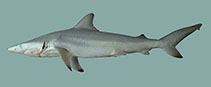
Duri punggung (Keseluruhan (total)) : 0; Duri dubur: 0. A small slender shark with a long narrowly rounded or somewhat pointed snout, no interdorsal ridge, small pectoral fins, a small first dorsal fin with an extremely long rear tip and a small low second dorsal fin with a long rear tip (Ref. 244). Back grayish or grey-brown, belly white; posterior margin of pectorals and ventral caudal fin lobe with an inconspicuous white edge; posterioventral and dorsal margins of caudal fin with a narrow black edge (Ref. 9997).
Body shape (shape guide): fusiform / normal.
Found in inshore and offshore waters of continental and insular shelves (Ref. 9997). Feeds mainly on fishes, also cephalopods and crustaceans (Ref. 6871). Viviparous (Ref. 50449). Of limited interest to fisheries due to its small size (Ref. 9997). Utilized fresh and probably dried-salted for human consumption (Ref. 244).
Viviparous, placental (Ref. 50449). 1 or 2 (usually 2) in a litter (Ref. 244). Size at birth 45 to 50 cm TL (Ref. 9997). Distinct pairing with embrace (Ref. 205). 12 months gestation period (Ref.58048).
Compagno, L.J.V., 1984. FAO Species Catalogue. Vol. 4. Sharks of the world. An annotated and illustrated catalogue of shark species known to date. Part 2 - Carcharhiniformes. FAO Fish. Synop. 125(4/2):251-655. Rome: FAO. (Ref. 244)
Status IUCN Red List (Ref. 130435: Version 2025-2 (Global))
penggunaan manusia
Perikanan: nilai komersial kecil
Alat, peralatan
laporan khas
muat turun XML
Sumber internet
Estimasi berdasarkan model
Suhu yang disukai (Acuan
123201): 24 - 29.1, mean 28 °C (based on 2308 cells).
Indeks keanekaragaman filogenetik (Acuan
82804): PD
50 = 0.5000 [Uniqueness, from 0.5 = low to 2.0 = high].
Bayesian length-weight: a=0.00457 (0.00278 - 0.00751), b=3.06 (2.92 - 3.20), in cm total length, based on LWR estimates for this species & Genus-body shape (Ref.
93245).
Tingkat Trofik (Acuan
69278): 4.2 ±0.4 se; based on diet studies.
Daya lenting (Acuan
120179): sangat rendah, Waktu penggandaan populasi minimum lebih dari 14 tahun (Fec=1).
Kerentanan Penangkapan Ikan (Ref.
59153): High to very high vulnerability (66 of 100).
🛈