分類 / 名前
共通名の | 類義語 | Catalog of Fishes(部類, 種) | ITIS | CoL | WoRMS | Cloffa
板鰓亜鋼(サメとエイ類) (sharks and rays) >
Carcharhiniformes (Ground sharks) >
Carcharhinidae (Requiem sharks)
Etymology: Carcharhinus: karcharos (Gr.), sharp or jagged; rhinus, an ancient name for sharks, from rhine (Gr.), rasp, both words alluding to a shark's jagged, rasp-like skin (See ETYFish); dussumieri: In honor of Jean-Jacques Dussumier (1792-1883), French voyager and merchant, who collected some of the type material off Bombay (Mumbai) [authorship often attributed to Müller & Henle, who published Valenciennes’ description] (See ETYFish).
Eponymy: Jean-Jacques Dussumier (1792–1883) was a French merchant, collector, traveller and ship owner. [...] (Ref. 128868), visit book page.
環境:環境 / 気候帯 / 深さの範囲 / 分布範囲
生態学
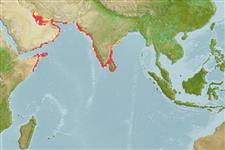
海 関連する礁; 深さの範囲 0 - 100 m (Ref. 106604). Tropical; 30°N - 5°N, 49°E - 84°E
Indian Ocean: from at least the Persian Gulf to India. Complete distributional range is unknown.
初回成熟時の長さ / サイズ / 重さ / 年齢
成熟: Lm 68.3, range 60 - 75 cm
Max length : 121 cm TL オス/雌雄の選別がない; (Ref. 114871)
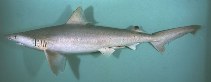
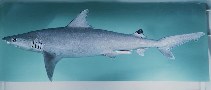
脊つい: 113 - 129. This small species is distinguished by the following characters: snout relatively long and narrowly rounded to almost pointed; upper anterior teeth are oblique and blade-like, coarsely serrated, with lateral margin deeply notched and with several large and serrated basal cusplets; lower anterior teeth are narrower, slightly oblique, lateral margins notched and usually without large basal serrae, finely serrated; total tooth row counts 27-29/24-30, or 52-59; interdorsal space often without a ridge, 17.9-20.8% TL; first dorsal fin relatively low and not falcate, origin over middle of pectoral-fin inner margin, length 14.3-16.2% TL, 1.4-1.6 times height, inner margin 2.2-2.5 in base; second dorsal fin is much smaller, broadly triangular, height 32-37% of first dorsal-fin height, origin about opposite anal fin origin; anal fin is slightly falcate, height 1.0-1.2 times second dorsal-fin height, base 0.9-1.1 times second dorsal fin base; body colour pale brownish dorsally, whitish ventrally; second dorsal fin with a black blotch on upper third of fin, not extending onto upper surface of body and very well defined from ground colour, while other fins mostly plain; total vertebral counts 123-138; monospondylous precaudal counts 42-48; diplospondylous precaudal counts 20; diplospondylous caudal counts 59-70; precaudal counts 62-68 (Ref. 89954).
Body shape (shape guide): fusiform / normal; Cross section: oval.
A common but little-known shark found on the continental and insular inshore areas (Ref. 9997). Feeds mainly on fishes but also on cephalopods, and crustaceans (Ref. 6871). Viviparous (Ref. 50449), with a yolk-sac placenta; gives birth to litters of 1-4 (usually 2) pups (Ref. 58048). Pregnant females (79-100.7 cm TL) that were caught contained 2-5 late-term embryos between 32-38.7 cm TL, thus birth size is presumed to be around 37-39 cm TL. From more than 1000 market specimens (in Kuwait, Qatar and Abu Dhabi), size of males and females range from 36-85 cm TL and 36-100.7 cm TL, respectively, with males reaching maturity between 63-80 cm TL (Ref. 89954). Taken in artisanal and small-scale commercial fisheries and marketed for human consumption (Ref. 244). Fins also utilized (Ref. 6871).
ライフサイクルと交尾行動
成熟 | 繁殖 | 放精 | 卵 | 生産力 | 幼生
Viviparous, placental (Ref. 50449). With 2 to 4 pups in a litter; 37-38 cm at birth (Ref. 244). Both male and females mature at about 70 cm (Ref. 6871). Distinct pairing with embrace (Ref. 205). No distinct seasonal reproductive cycle apparent, instead continuously breeding with most mature females pregnant or spent at any one time (Ref.58048).
White, W.T., 2012. A redescription of Carcharhinus dussumieri and C. sealei, with resurrection of C. coatesi and C. tjutjot as valid species (Chondrichthyes: Carcharhinidae). Zootaxa 3241:1-34. (Ref. 89954)
IUCNのレッドリストの状況は (Ref. 130435: Version 2025-2 (Global))
絶滅危惧 (EN) (A2d+3d); Date assessed: 07 August 2018
人間の用途
水産業: 商業
用具
特記事項
XMLをダウンロードして下さい
インターネットの情報源
モデルに基づく推定値
好ましい温度 (参照
123201): 24.2 - 28.5, mean 27.1 °C (based on 230 cells).
系統多様性指数 (参照
82804): PD
50 = 0.5000 [Uniqueness, from 0.5 = low to 2.0 = high].
Bayesian length-weight: a=0.00331 (0.00219 - 0.00502), b=3.08 (2.96 - 3.20), in cm total length, based on LWR estimates for this species & Genus-body shape (Ref.
93245).
栄養段階 (参照
69278): 3.9 ±0.0 se; based on diet studies.
回復力 (参照
120179): 非常に低い, 14年以上の倍増期間の最小個体群 (Fec=2).
漁業の脆弱性 (Ref.
59153): High vulnerability (56 of 100).
🛈
栄養素 (Ref.
124155): Calcium = 9.67 [1.95, 51.08] mg/100g; Iron = 0.451 [0.117, 1.280] mg/100g; Protein = 22 [19, 24] %; Omega3 = 0.112 [0.046, 0.250] g/100g; Selenium = 29.7 [7.8, 79.1] μg/100g; VitaminA = 60 [25, 149] μg/100g; Zinc = 0.659 [0.316, 1.270] mg/100g (wet weight);